The Helix Loop / Helix Loop
Agent Watch #5: Hand over the work, keep your understanding
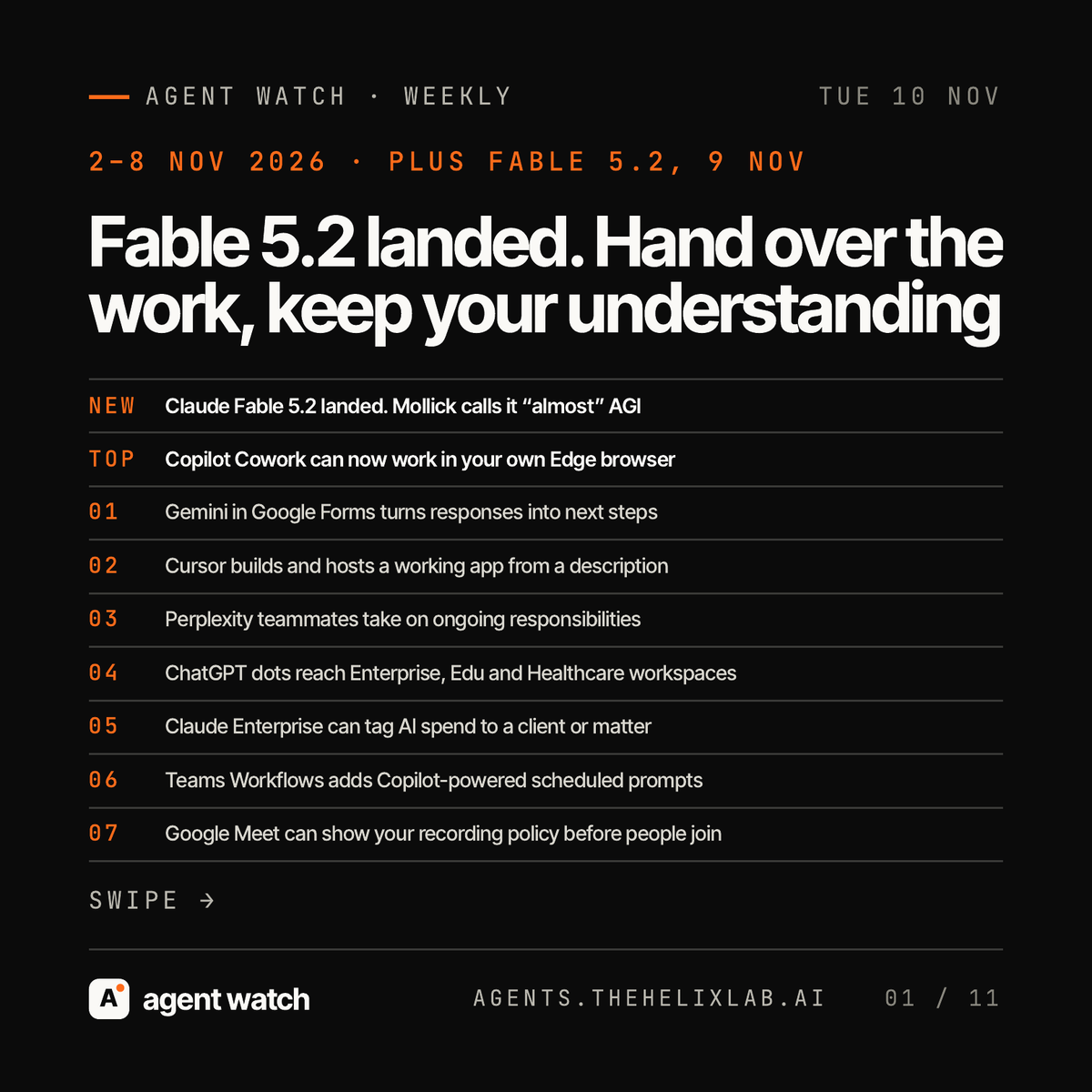
Copilot Cowork uses your signed-in Edge browser. Forms analyses responses. Cursor builds live apps. Plus Fable 5.2 and Mollick's early tests.
The Helix Loop, 11 November 2026
This issue covers 2 to 8 November, plus Anthropic's release of Claude Fable 5.2 on 9 November.
Claude Fable 5.2, released 9 November
Anthropic released Claude Fable 5.2 and Claude Mythos 5.2 on 9 November. They are the same underlying model. Fable has additional cybersecurity and biology safeguards that allow Anthropic to make it available to all users. Organisations can apply for Mythos through Anthropic's verification programmes.
Anthropic says the models generate outputs up to 30% faster than their 5.1 versions. It still recommends starting with Claude Opus 5.5 for most coding and knowledge tasks. Anthropic announcement.
Ethan Mollick had early access. He calls Fable 5.2 "almost" AGI, or Jagged AGI. He uses a limited definition of AGI, "an AI as good as most human experts at most intellectual tasks you can do with a computer". That is his assessment, not an established classification.
His examples are worth reading. A university course Fable rebuilt was initially "accurate and joyless". A research paper ran to 182 pages because each critique added another analysis and nothing was cut. Mollick says no human, including him, had fully checked the results.
His 3D-worlds project grew to a lead agent and 28 agent teams. When he asked them to polish the worlds, they added rules and approvals. The rule book eventually reached 204 sections and 87,500 words.
Across his projects, Mollick used critics, fact-checkers or judges. He writes, "None of them asked whether the work was too long, too repetitive, or no fun. That all fell on me." Mollick's account.
My starting point is to hand over the work while keeping enough understanding to question it. I still decide what is useful and what is ready to put my name to.
What's important
Copilot Cowork can work in your local Microsoft Edge browser, including on sites where you are already signed in. It can navigate pages, gather information, fill forms and complete supported actions. Credentials, cookies and session tokens stay on your device.
Microsoft documented this in its 4 November release notes, which cover releases between 28 October and 3 November. The notes do not give the feature's exact launch date. Cowork works in a separate Edge tab while you follow progress in its conversation. Existing browser, identity and data protection policies still apply. Official source.
Start with a bounded task whose result you can inspect. You choose the sites and actions, provide input or approval when prompted, and check the outcome. Being signed in does not decide whether an action is appropriate.
What changed for knowledge workers this week
These are the other changes in the 2 to 8 November source set. Dates refer to the announcements or documentation unless a rollout date is stated.
- Gemini in Google Forms analyses responses by writing and running Python code. It finds trends and relationships between answers, then recommends next steps. Google's 5 November announcement says Rapid Release rollout began on 2 November for eligible plans. Scheduled Release starts on 19 November. You check what the responses support before acting on a recommendation. Official source.
- Cursor can build a web app from a description, set up a database and sign-in, and host it at a shareable link. The 5 November release is available on all paid plans with cloud agents enabled. Nothing goes live until security checks pass and you explicitly publish. You choose who can access the app and check how it handles work data. Official source.
- Perplexity teammates is in research preview for individual Max subscribers on the web, announced on 6 November. These agents have ongoing responsibilities, coordinated tasks and connected tools. If you have access, set the remit, permissions and escalation rules before assigning recurring work. Official source.
- ChatGPT dots are available to eligible Enterprise, Edu and Healthcare workspaces. They can continue working between conversations. OpenAI's 4 November notes give admins until 18 November to opt out before default availability. Admins can control access, inspect dots and connections, and pause or resume them. UAE data or inference residency workspaces are excluded. You still need to decide what each dot is responsible for. Official source.
- Claude Enterprise project tags can attribute most supported project spend to a charge code or client-matter number. The beta has eligibility restrictions, including exclusions for organisations using zero data retention, customer-managed encryption keys or data stored outside the US. Work outside a project is not tagged. Choose valid codes and reconcile the figures before billing a client. Official details.
- Teams Workflows adds Copilot-powered scheduled prompts and customisable templates for multi-step tasks. Microsoft's 4 November notes describe the feature on Windows and Mac. Access depends on Teams app management settings. You set the inputs, timing and approval points for a recurring update or process. Official source.
- Google Meet can display an administrator-set policy notice before people join a call. The notice can appear for every call, or when recording, transcription or Gemini notes are active. It is off by default. Google's 3 November announcement says rollout began on 2 November for eligible editions. The organisation still decides when recording or AI notes are appropriate. Official source.
For coders, briefly
GitHub's app in Slack and Teams became generally available on 6 November. It can investigate bugs, create issues, implement changes and open pull requests from a conversation. Teams also gets Canvas for reviewing implementation plans, code changes and previews together. People still review the proposed changes. Official source.
What to borrow from coders
Here are three exercises for your own work. They are suggestions to try, not claims about measured results.
Form your own view
Before asking AI to review a contract, brief or forecast, write down your expected conclusion and why. Compare its explanation and sources with yours. Check the disagreements yourself.
Assist means AI helps me think; I decide.
Keep a shared playbook
Write the method for a recurring board paper or month-end commentary in a shared file. Include the required inputs, steps and checks. When you correct the AI, update that method so the correction is available next time. You approve changes and exceptions.
Adapt means AI works within rules I set; I stay on call.
Inspect the trail
For a multi-step task, ask for the files opened, sources used, changes made and steps skipped. Compare that record with the deliverable. Open the sources and changed files yourself. A completion message is not a substitute for checking the work.
Augment means AI carries several steps; I review.
One thing to try this week
Choose a familiar task. Write your expected answer, supply your method and ask AI to prepare the work with a source-and-change record. Review both. Keep the useful corrections in your method for next time.
Follow along
Explore the Agent Watch tracker and What changed ledger.
Subscribe to The Helix Loop and get Agent Watch every week.
If you want to practise these modes on your own work, Craft is where I work through them.
Suhit