The Helix Loop / Helix Loop
AI governance isn't spelling. It's phonetics.
What fixing my dictation taught me about the layer most AI governance frameworks are missing.
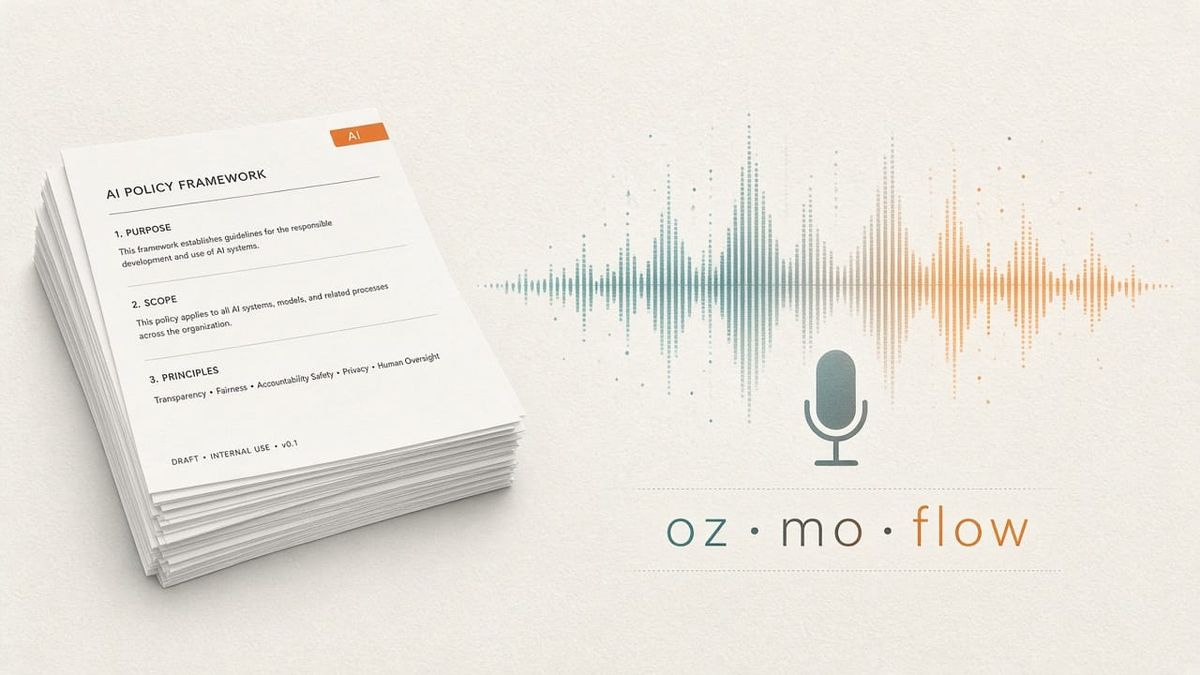
A few weeks ago I was dictating notes on Omarchy — my AI-native Linux workstation — and the transcription came back with "Timberlink and Nosmoflow and Nextimator."
I'd said "Timberlink and Osmoflo and NeXTimator." Three client and product names. All wrong.
What happened next taught me something I didn't expect about AI governance.
Two layers, not one
The obvious fix was to add those terms to my vocabulary list. I did that. But in building the pipeline — 245 terms, 53 phonetic hints, a Git-backed scan/curate/apply cycle — I found something that matters beyond dictation.
There are two entirely separate layers of correction, and they are not the same.
The orthographic layer fixes what the AI gets wrong when the written form is close to the intended word. "Nextimator" — misspelled, but the letters are mostly there. The recogniser figures it out from the spelling alone. No special instruction needed.
The acoustic layer is different. "Nosmoflow" cannot be fixed by any spelling rule. No rewrite gets you from "Nos" to "Oz." The recogniser heard the phonemes correctly — it just mapped them to words that made acoustic sense. To get "Osmoflo," you need an explicit phonetic hint: oz mo flow.
I'd been checking my vocabulary with vocab preview and thinking: if it looks right, it works. It doesn't. Preview exercises only the orthographic path. It's a floor, not a ceiling. The acoustic problems are invisible to it.
The governance version of this problem
Then I realised: this is exactly what's happening in AI governance in most organisations I work with.
They're building orthographic governance.
Better policies, clearer guidelines, improved prompts. All corrections at the written rule level — close enough to the right behaviour that the AI gets there. Necessary, but only one layer.
The problems that keep surfacing in practice are acoustic. The right answer departs from the written rule, and no rewrite of the policy gets there. These are the decisions where experienced practitioners know "the policy says X, but in practice we always Y when Z" — where edge cases reveal real organisational knowledge that no policy document holds.
The decisions your AI keeps getting wrong despite good policies aren't a spelling problem. They're acoustic.
For an AI to handle these correctly, it needs the equivalent of a phonetic hint. Not a better policy — an explicit record of what the right answer is in this situation, and why. What signals matter. What trade-offs were weighed. What would change the answer.
What this looks like in practice
A few months ago I was working with a team on their AI governance framework. Solid policies, well-written. The orthographic work was good.
We sat five experienced practitioners down and walked through twelve edge cases in their decision workflow. They disagreed on four. Not because anyone was wrong — because the right answer depends on context and accumulated judgement the written policy can't fully encode.
Those four disagreements are the acoustic layer. They need explicit capture: which signals matter, what trade-offs were weighed, what would change the answer. A governance framework without those records is running vocab preview and calling it done.
The honest trade-off
There's a related principle from my own work: a gate that can't be enforced implies a control that doesn't exist. It's worse than nothing — it creates the appearance of governance while providing none of the substance.
The same applies to AI policies that say "must not decide X" when there's no mechanism to verify it. Separate what orthographic governance can actually enforce from what requires acoustic capture to work. Write the policies you can enforce. Build explicit records for the decisions that need them.
The question worth asking
When I work with clients now, I want to ask: what are your Nosmoflow problems?
Not the decisions where the AI gets it wrong in a way that's obviously fixable — those are orthographic. I want the ones where you've tried better policies, clearer guidelines, improved prompts, and the AI still produces the wrong output. Because the right answer lives in practitioner judgement that the written rule can't reach.
Those are the problems that governance frameworks typically can't see. vocab preview says everything is fine. The hard names are still being mis-heard.
Fixing them doesn't require better spelling. It requires phonetics.