The Helix Loop / Helix Loop
Data, judgement and the courage to take a chance: what Kimi Antonelli's title teaches leaders
Mercedes found him at 11, backed him for nine years and bet on a teenager. Then he kept the number 12 to stay humble.
The Helix Loop, 3 November 2026
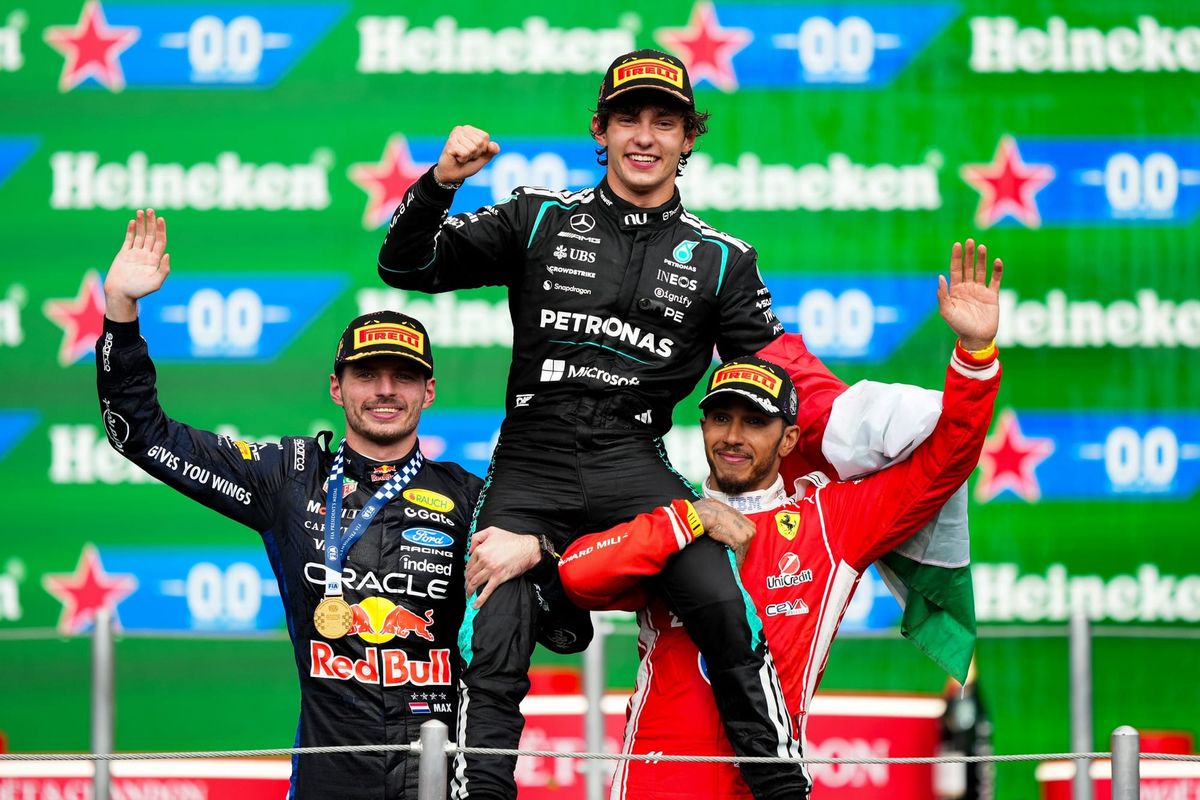
Max Verstappen and Lewis Hamilton lifted Kimi Antonelli onto their shoulders on the podium in Mexico City.
Eleven world titles between them, four for Max and seven for Lewis, holding up the newest champion.
Kimi is 20 years and 68 days old. He's now the youngest Formula 1 world champion ever, beating Sebastian Vettel's record of 23 years and 134 days from 2010. He's the first Italian champion since Alberto Ascari in 1953. He did it in his second season, with four races still to go.
That photo will be the one everyone remembers. The story behind it is the one I keep thinking about, because it has everything a leader needs right now: data, human judgement, the patience to grow talent, a team that puts it all together, and the courage to take a chance.
It started with judgement, not results
Mercedes first watched Kimi in 2017, when he was 11. Giovanni Minardi told Toto Wolff about him, and Toto sent Gwen Lagrue, who runs the Mercedes junior programme, to have a look.
Lagrue gets "a hundred calls a week saying, 'We found the new Ayrton Senna.'" So he went quietly. "I go and I try to be as quiet as possible, hiding myself somewhere on track," he told Motor Sport Magazine. He watched two or three races before he said a word.
Kimi's karting results back then were patchy. "When I first met him, he was not dominating because he didn't have the right equipment, but he was by far the best of his team and maximised what he had," Lagrue said.
So Lagrue looked past the scoreboard. He watched how Kimi handled the good and bad moments, how he recovered after a disappointment, how he was with his team. The first Mercedes deal came in 2018. That year Lagrue moved him to a kart team that was winning everything, and "from there he was just flying."
That's human judgement. The results said "maybe". A person who had watched Hamilton, Vettel, Verstappen and Russell come through saw something the numbers didn't show yet.
Then nine years of encouraging talent
Toto summed it up after the race: "This is nine years of development. From when he was 11, the mentoring, the support, the psychological development, the technical ability, the many, many difficulties, the testing."
Some of that was physical. Mercedes hired a coach because, in Lagrue's words, "He was a little bird." Some of it was personal. "He likes to please people and sometimes we need to teach him to say no."
And some of it was tough. Kimi skipped F3 and went straight to F2, where his team struggled. His first public run in the Mercedes F1 car, at Monza in 2024, ended in the wall at Parabolica on his second flying lap. Toto still announced him the next day, and privately he was raving about how fast Kimi had been earlier on that same lap.
His first F1 season had hard moments too. "There were people who questioned whether he was ready for Formula One and whether he deserved to be in a Mercedes," Toto said after the race. "We always believed in his talent and knew those difficult experiences would make him stronger."
Kimi felt it. "Mercedes has believed in me for so many years and given me this incredible opportunity, so to repay that trust by winning the World Championship together means so much."
And data behind every step
This wasn't a gut call either.
F1 rules stop teams testing their current car, so Mercedes put Kimi in older ones. His first test was two days in the 2021 car at the Red Bull Ring, about 500km in rain and snow. Then came days in the 2022 car at Imola, Silverstone and Spa, and time in the simulator at the factory in Brackley, learning tracks and steering-wheel procedures.
Every lap made data. Toto's words: "But we had the data, so in a way when Lewis told me I'm out of here, it was clear that that was the successor." He made the call, as he put it, "five minutes after Lewis told me that he's going to Ferrari."
The courage to take a chance
Data alone didn't put a teenager in Lewis Hamilton's seat. Someone had to decide.
Mercedes made the call early and kept a backup plan. "We had almost a year, and in the worst-case scenario we will see if he is not ready and we can still call another driver and have a B-plan," Lagrue said. "But what we saw reassured us."
That's what courage looks like in a well-run team. They didn't bet blind. They used the data to make the bet smaller, and then they made it.
It paid off. Kimi went into Mexico 123 points clear of his team-mate George Russell. He needed ninth. He started fourth, kept his soft tyres going for more than 40 laps, lost the advantage when a red flag stopped the race, restarted fourth, passed Charles Leclerc into Turn 1 and finished third. That was his 17th podium of the season.
A new kind of champion
Then he did something that made me stop.
The champion gets to run number 1 next year. Max did. Lando Norris did. Kimi said no.
"I'll stay with number 12 because, obviously, it's a very special number for me, but also it's a way for me to stay grounded, to stay humble," he said. "I feel like by keeping number 12 it allows me to have a new point where to start and build on everything again and try to improve."
Number 12 is Ayrton Senna's number from his first title in 1988. Kimi is the first champion to win with it since.
Toto went further. Without being asked, he said this at the end of his media briefing: "This notion of win at all costs, selfish, opportunistic, ruthless for your own benefit, that model of racing driver has died. We have a new champion that represents values like humility, like integrity, loyalty, respect."
And: "Look at this kid of 20 years, and then think what you can do in order to improve."
Humility as a starting point for learning. A world champion who treats the title as a new place to start. That's the attitude this new age needs. AI is moving too fast for anyone to lead it by pretending they already know everything. The leaders who keep learning will be the ones still standing.
What it adds up to: the co-intelligent organisation
Here is what I take from Mexico City.
You need data. Thousands of kilometres in old cars and hours in the simulator gave Mercedes evidence, not a hunch.
You need human judgement. Lagrue saw past patchy results at 11. The data told them how fast Kimi was. People told them who he was.
You need to encourage talent. Nine years of mentoring, coaching and support through the crash, the hard F2 year and the critics.
You need to bring it together. That's what a co-intelligent organisation does. Systems give the signal, people give the judgement and care, and neither wins on its own. As Toto said after the race: "Championships are never won by one individual."
And you need the courage to take a chance. Somebody has to say "it's him" when the safe choice is sitting right there.
Most organisations do the opposite. We read the CV, we let patchy early results count against people, we promote the safe pick, and we expect confidence in place of humility. Then we wonder why nobody surprises us.
So here's my question for you this week:
Who in your team is the 11-year-old with patchy results, and what data, judgement and courage would it take for you to back them?
Suhit