The Helix Loop / Helix Loop
Harness before model
The model debate misses a more useful question: where should intelligence sit in the work, and who keeps the judgement?
The meeting always starts the same way.
Someone has opened three tabs. ChatGPT. Claude. Copilot. Sometimes a fourth “the new one.” The question lands with the weight of a procurement decision:
Which model should we standardise on?
I used to answer it. Now I try not to.
Because the fight in the room is already outdated. The real split is not between brands. It is between how the work is held.
The inversion
Model is fuel. Harness is the job.
A model is the intelligence — next words, next step, next guess.
A harness is the place that intelligence is employed: what it can see, what it can touch, how long it can stay with the work, and who is accountable when it finishes.
Same brain. Different workplace. Different outcome.
Open the same model in a chat window and you get a conversation.
Open it in a project agent that can hold files and multi-step work and you get a colleague with a desk.
Open it in a coding environment against a live system and you get something that changes the system.
We keep shopping for engines. The week is decided by the vehicle.
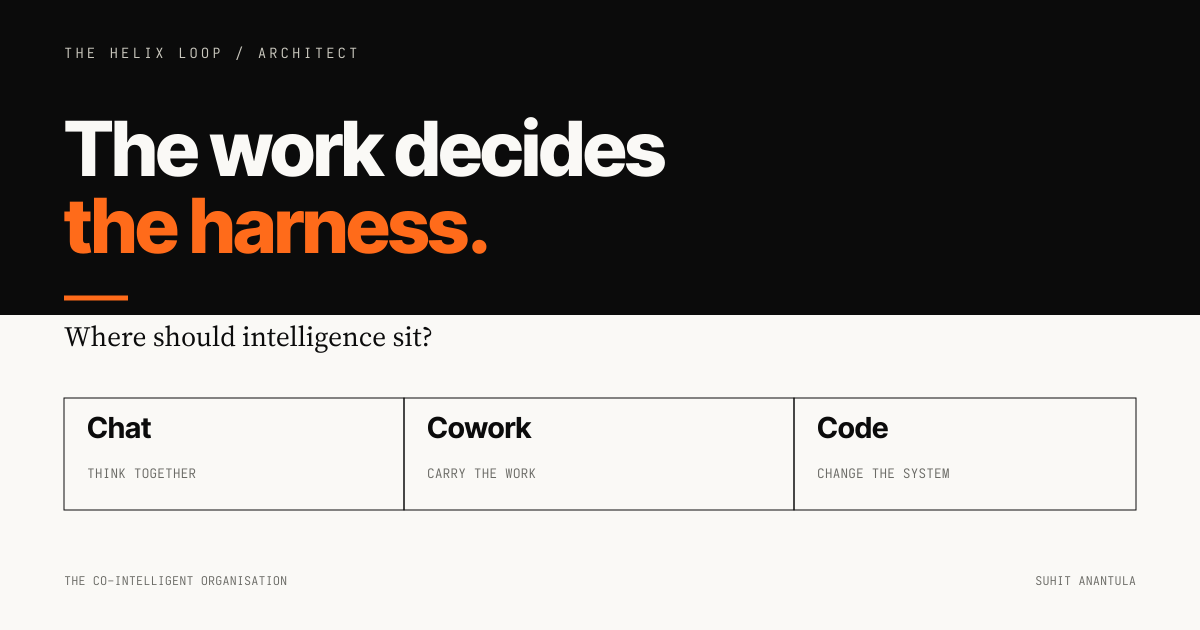
Name the three places
Every serious AI product now has some version of three harnesses. The logos differ. The jobs rhyme.
Chat is conversation. You are thinking with it — draft, decide, rehearse.
Cowork is an agent on a stretch of real work. You are co-producing — packs, research, multi-step jobs — still under your goal.
Code is an environment that can change systems. You are designing loops that run; you handle the exceptions.
Thirty-second rule:
- Need a decision, a claim, a piece of prose? → Chat
- Need a pack of work that is not primarily a software change? → Cowork
- Need the system itself to change? → Code
Wrong harness is expensive. Strategy in a code agent becomes a fake architecture repo. A build that only lives in chat becomes a beautiful plan that never ships.
Why most “AI training” still fails Monday
Organisations bought the licences. People got a lunch-and-learn. A few power users took off. Everyone else went back to email.
The tools arrived. The way of working did not.
What was missing was not another certificate in “prompting.” It was a simple, shared answer to two questions on real work:
- How much help is this task allowed to get?
- What judgements stay with the human — always?
Without that, chat becomes a secret butter knife, cowork becomes shadow labour, and code becomes something “only the tech people do.” Leaders still ask which model to buy. The week does not move.
What we built for that gap
I did not want another tool course. I wanted a practice — something people could run on the work they already carry.
So we built Helix Craft: a guided path for knowledge workers and leaders to learn those three places as stances, not as brand loyalty.
We use plain words for the stances.
Assist — you stay at the helm. AI helps you think. It does not own the call. That usually lives in chat.
Augment — you stay in the loop. AI carries multi-step work. You review and decide. That usually lives in cowork.
Adapt — you go on call. The loop can run without you hovering because you designed the boundaries. That lives in code and systems — only when earned.
Most people need strong Assist and Augment. That is competence.
Some go further into Adapt. That is not “better person.” It is a different job: designing work that creates value without your constant attention — while you still own the exceptions and the lines that must never automate.
Craft is deliberately not “become an engineer.” It is how you choose the right kind of help on purpose, on Monday’s brief, proposal, decision pack, or client work — with whatever ChatGPT, Claude, or Copilot you already have.
Helix Practice Lab is the same practice for a team or function — not a big classroom that never changes the week. Small working cells. Live artefacts. Shared language for when AI may think with you, when it may carry steps, and when a human must still decide. Leaders who sponsor a Lab are not buying a tool tour. They are installing a way of working.
If an organisation needs systems built for them, that is a different engagement.
If leadership needs a longer season to absorb AI into how the institution leads, that is a different path again.
We keep those buys honest. The ladder underneath is still the same three places and three stances.
What this looks like when it is real
I have watched the same ladder on my own desk this year.
A hard conversation gets thought through in chat — claim, posture, what not to promise.
The pack gets built as cowork — files, structure, the thing you can hand someone.
The system changes in code — agents, repos, crews — while send, publish, and merge stay human.
Leaders do not need my machine. They need the same progression on their work, with their tools already at their fingertips.
The missing layer was never another model. It was a shared way of working.
Useful move
Before you open any AI this week, write two lines on the task in front of you:
- Which place is this? Chat, cowork, or code.
- Which stance am I in? At the helm, in the loop, or on call — and what will I still decide.
If you cannot answer both, you do not have a practice yet. You have a tab.
The diagnostic is not which model.
It is for this work, where should the intelligence sit — and who keeps the judgement.
If you want a path to practise that on work you already carry — not another tool course — that is what Helix Craft is for: craft.thehelixlab.ai.