Helix Moment : AI Collaboration Modes
The Helix Moment explores how we think, design and lead in the co-intelligence age.
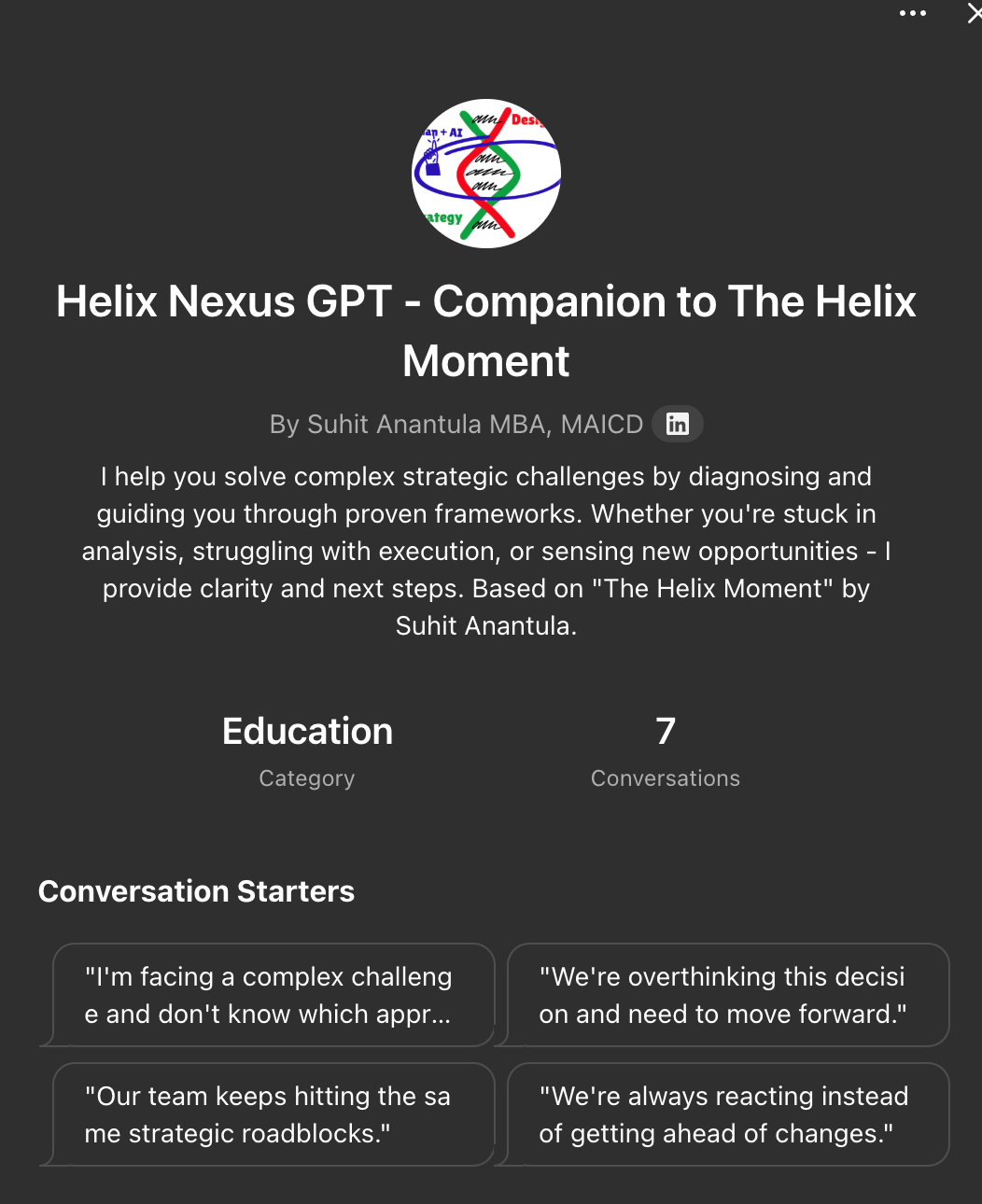
The Helix Moment: How to Think, Lead and Design in the Co-Intelligence Age is the first business strategy book to come with a dedicated AI thinking partner—Helix Nexus—a live, working embodiment of the ideas inside the book.
More here.
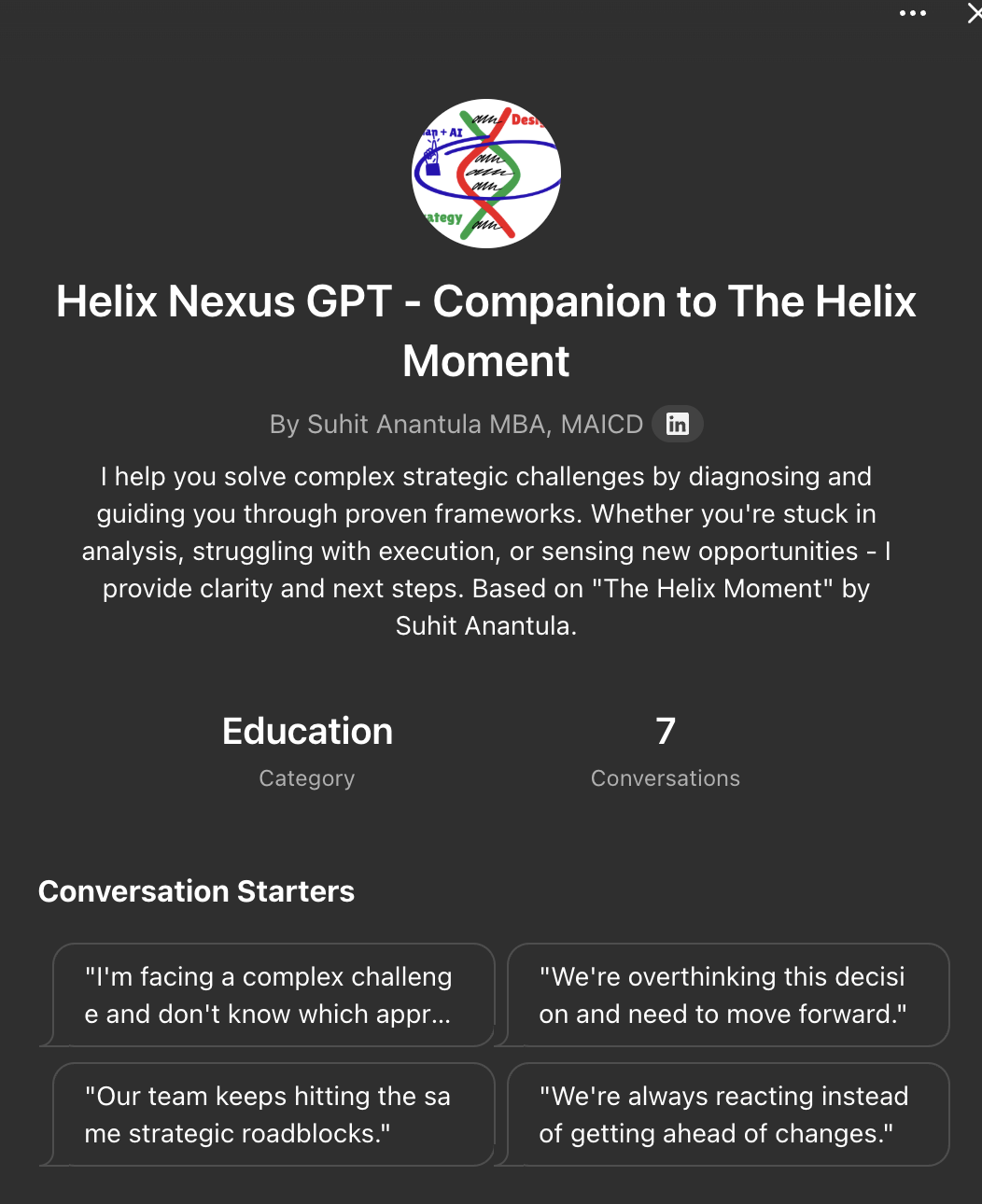
To give you a sense of the power of Helix Nexus GPT. I asked it to show how we can collaborate with AI. As the GPT is trained by me on the books knowledge and giving it guidance and support on how to respond and answer to questions, it gave a pretty good response that I am pasting directly here.
<Response Starts>
"How can I develop better AI collaboration using the four modes?"
Great question — you're stepping right into the heart of rhythm intelligence with AI-in-the-loop design. The four modes (Amplifier, Mirror, Partner, Capability) are not just tools; they are rhythm levers that let you dynamically switch between ▲●〰 depending on your collaboration context.
Let’s unpack how to develop better AI collaboration by aligning each mode with rhythm intelligence:
🔄 The 4 Modes of AI Collaboration — and Their Rhythm Intelligence
1. Mode 1: AI as Amplifier
Rhythm Signature: ▲ execution + ● acceleration
Use it when: You know what to do, and need scale/speed.
Develop it by:
Defining ▲ clear prompts and structured tasks for AI
Using AI for drafting, summarizing, or organizing — speeding up ● iteration loops
Example: AI summarizes meeting notes or drafts blog posts from outlines
✅ Prompt shift: “Give me 5 options for how to present this idea clearly to my team.”
2. Mode 2: AI as Mirror
Rhythm Signature: ● reflection + 〰 pattern sensing
Use it when: You want to challenge or clarify your thinking.
Develop it by:
Asking AI to reflect back your assumptions or reframe your ideas
Using it to reveal bias, blind spots, or inconsistencies (〰)
Example: AI critiques your strategy from another perspective
✅ Prompt shift: “What am I not seeing here? What’s a counter-view to my plan?”
3. Mode 3: AI as Partner
Rhythm Signature: ●〰 co-creation + rhythm switching
Use it when: You want real-time, high-cognitive collaboration.
Develop it by:
Working with AI in iterative loops: ideate, refine, adapt — not just execute
Letting the AI introduce creative tension or unfamiliar insights (〰 disrupts ▲ rigidity)
Example: Designing a product or scenario planning with branching outcomes
✅ Prompt shift: “Let’s explore three futures together. Help me map implications and contradictions.”
4. Mode 4: AI as Capability
Rhythm Signature: ▲ automation + 〰 orchestration
Use it when: You want to delegate entire workflows.
Develop it by:
Embedding AI into operational flows (e.g., auto-tagging support tickets, summarizing research)
Shifting your role to strategy (you design the system; AI runs the loops)
Example: AI handles ongoing competitor analysis while you scan for new strategic directions
✅ Prompt shift: “Create a repeatable process to monitor this trend weekly. Show me how to refine it.”
📊 Rhythm Intelligence Development Guide
Mode Rhythm Leverage You Evolve From… …To Amplifier ▲● Doing tasks yourself Delegating low-cog tasks with precision Mirror ●〰 Unquestioned assumptions Reflective strategy + better decision hygiene Partner ●〰▲ Solo ideation Co-creative flow and expanded cognition Capability ▲〰 Manual processes Scaled systems with human-in-the-loop oversight
🔁 Multi-Rhythm Maturity Tip
Most people get stuck in Mode 1 (▲ use-AI-as-tool thinking) — but true rhythm intelligence grows when you flow across modes:
- Design your day with Amplifier (▲●), Mirror (●〰) and Partner (●〰▲) rhythms in mind
- Design your organization with Capability (▲) supporting human creative loops (●) and sensing layers (〰)
💡 Start Here: Personal Practice Prompts
- What ▲ structured tasks could I offload today using AI as Amplifier?
- Where am I stuck in my own ● loop that could benefit from an AI Mirror?
- What 〰 emergent ideas could AI and I co-create as Partners this week?
- How might I build an AI Capability so I can focus on more strategic or human-centric work?
Want to go deeper?
📘 "The Helix Moment" by Suhit Anantula includes full-mode collaboration case studies (like Stitch Fix’s AI-human stylist synergy). You can explore them at www.thehelixmoment.com
📊 For org-level application, see www.suhitanantula.com
Ready to map your current rhythm mode usage? I can help you diagnose where you're over-relying on one mode or missing a key rhythm. Just tell me how you're currently using AI.
<Response Ends>
Explore the GPT and get a sense of what the book is about and please share your thoughts with me. I am keen to develop the Helix Nexus and companion digital tools to support the book.