The AI Adoption Gap: Why Organisational Absorption Determines Everything

The capability gap isn't technical—it's organizational. And if you don't understand the difference between Assist, Augment, and Adapt, you're solving the wrong problem.
The Real Challenge
AI capability keeps climbing.
That's not news anymore.
What is news: organisational absorption capacity isn't keeping pace.
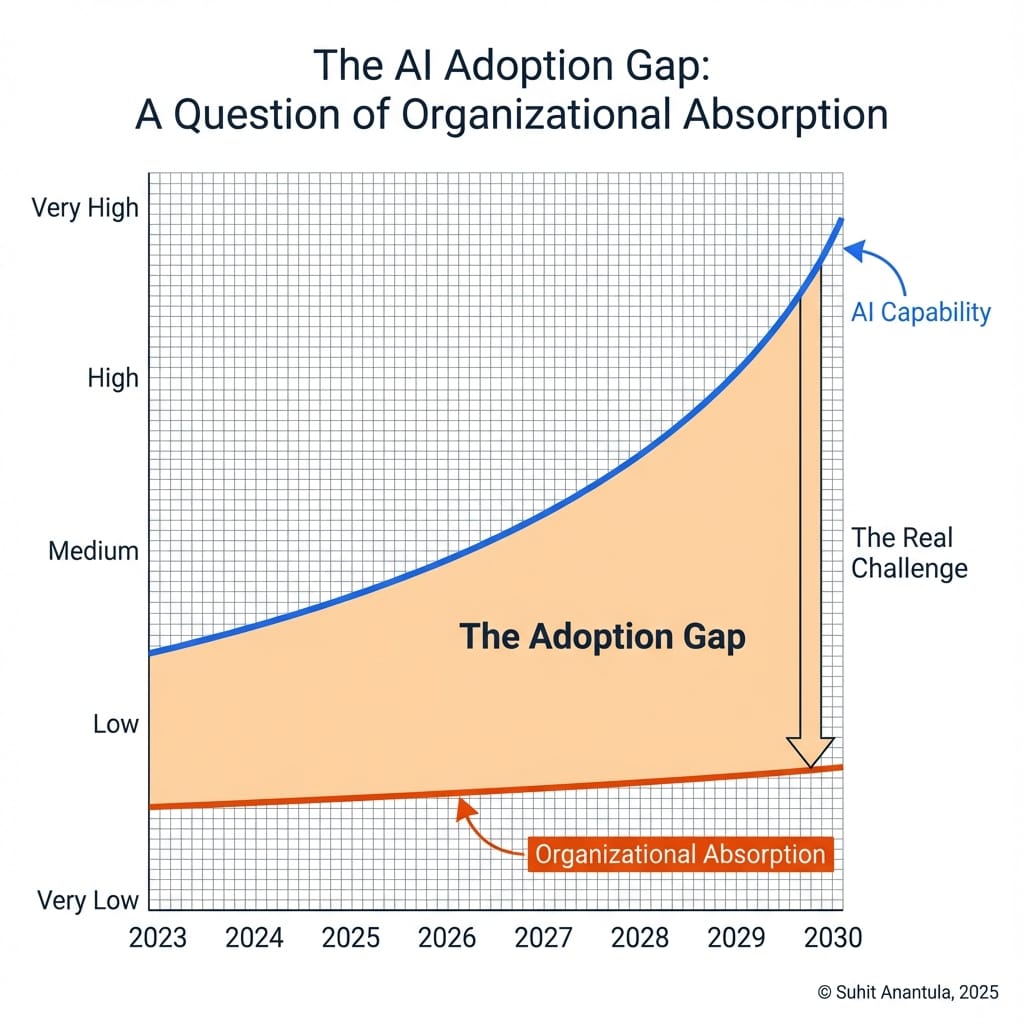
Look at the chart. That growing gap between what AI can do and what organisations can actually implement isn't a technology problem.
It's an absorption problem.
And absorption capability determines adoption capability.
Watch it on YouTube on Subscribe on Spotify and Apple Podcasts.
Why Most Organizations Are Stuck
Here's what I see across government and enterprise clients:
Organizations treat AI transformation as a technology project.
They shouldn't.
AI transformation is an organizational capability project.
The bottleneck isn't the model. It's the operating system around it:
- How decisions get made
- How work flows
- How people learn and adapt
- How systems integrate
- How governance works
Technology readiness outpaces organizational readiness every single time.
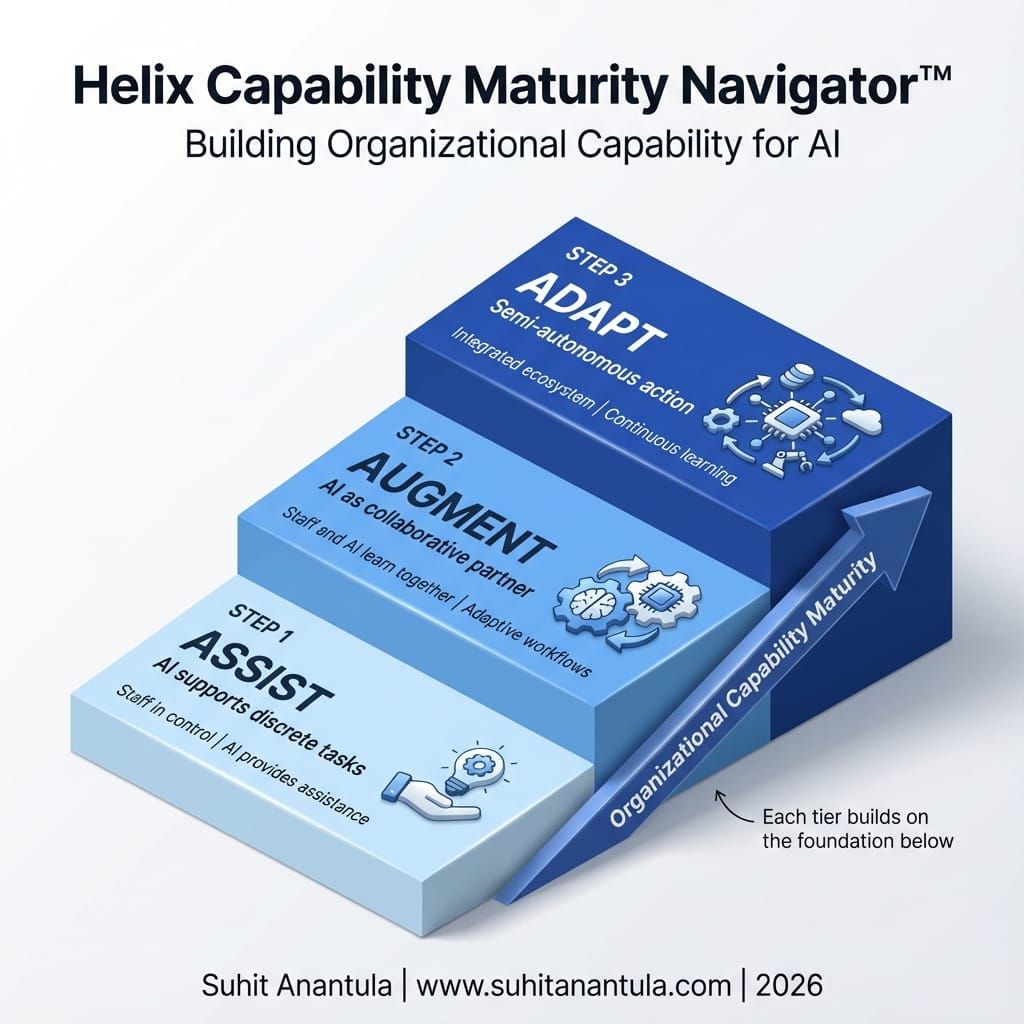
To help make sense of this, I created Helix Capability Maturity Navigator. These match technological capability with organisational capability.
Three simple levels - Assist, Augment and Adapt.
Each opens up to what AI and Agents can do and more importantly provides a lens into where you are now and where you need to go to match your ambition.
Using and testing this with my clients it is working across industries, size of organisations and Executives love this.
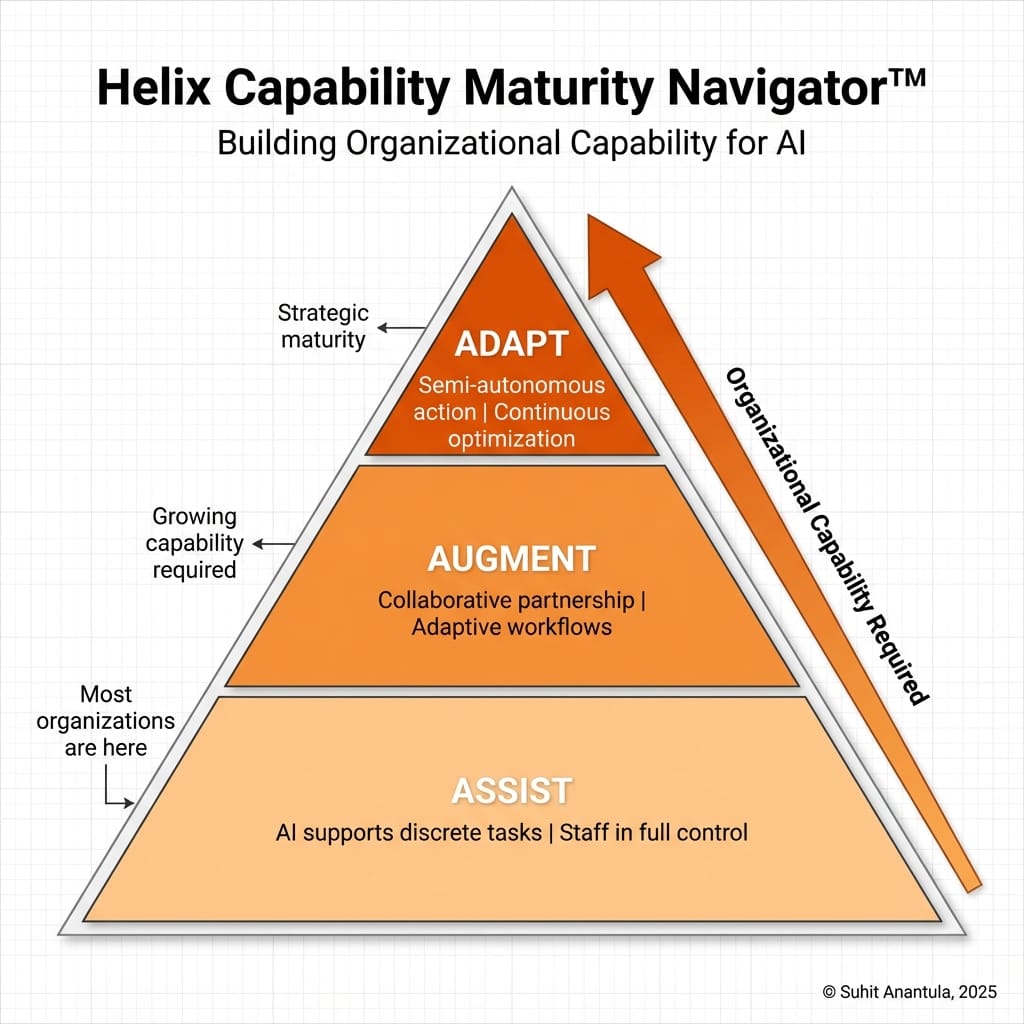
The Three Tiers: Assist → Augment → Adapt
Most organizations are stuck at Assist—and they don't even know it.
Let me show you what each tier actually means.
Tier 1: ASSIST
AI supports discrete tasks—staff are in full control
This is where most organizations live today.
What it looks like:
- Using Copilot to summarize meeting notes
- Drafting email responses with AI assistance
- Searching for information with AI tools
- Staff member initiates, reviews, decides
The pattern: Human-led, AI-assisted. One task at a time.
Why organizations stay here: It's safe. It's incremental. It doesn't require changing how work actually happens.
The problem: You're treating AI like a better search engine. You're not transforming anything.
Tier 2: AUGMENT
AI becomes a collaborative partner—staff and AI learn from each other
This is where the real transformation begins.
What it looks like:
- An AI system that learns from your development application patterns
- Proactive suggestions based on historical data
- Adaptive workflows that improve over time
- Staff and AI in genuine partnership
The pattern: Bi-directional learning. The AI doesn't just respond—it adapts.
Why most organizations can't get here: It requires:
- Data foundations that work across systems
- Integration between platforms
- Governance frameworks for AI-human collaboration
- Trust in semi-autonomous systems
The unlock: When you hit Augment, you're no longer automating old processes. You're creating new capabilities that didn't exist before.
Tier 3: ADAPT
AI takes semi-autonomous action with human oversight
This is strategic maturity.
What it looks like:
- Community engagement systems that adapt communication strategies in real-time
- Service delivery that adjusts based on demand patterns
- Resource routing that optimizes intelligently
- Integrated ecosystems that continuously learn
The pattern: AI-led, human-overseen. The system acts, humans guide.
Why almost no one is here yet: It demands:
- Deep organizational trust
- Mature governance
- Robust data infrastructure
- Cultural readiness for delegation to AI
The payoff: Continuous optimization. Compounding advantage. True transformation.
The Helix Capability Maturity Navigator™
Here's how we measure where organizations actually are.
Seven dimensions. Three tiers. Evidence-based assessment.
The Seven Dimensions:
- Data Foundations
Quality, accessibility, and ethical management of organizational data - System Integration
How well technology platforms connect and share information - Human-AI Interaction
How staff understand, use, and collaborate with AI tools - Governance & Risk
Ethical safeguards, decision-making protocols, risk management - Inclusion & Accessibility
Whether AI solutions work equitably for all staff and community - Organizational Readiness
Culture, leadership support, funding, change capability - Business Value
Measurable impact on outcomes and operational effectiveness
Why the Pyramid Matters
Notice the visual: each tier builds on the foundation below.
You can't skip to Adapt.
You can't even sustain Augment if your Assist foundation is shaky.
Most organizations:
- Want to be at Adapt (strategic maturity)
- Claim they're at Augment (collaborative partnership)
- Actually stuck at Assist (task-level support)
The gap between where you think you are and where you actually are? That's organizational absorption capacity.
The Staircase
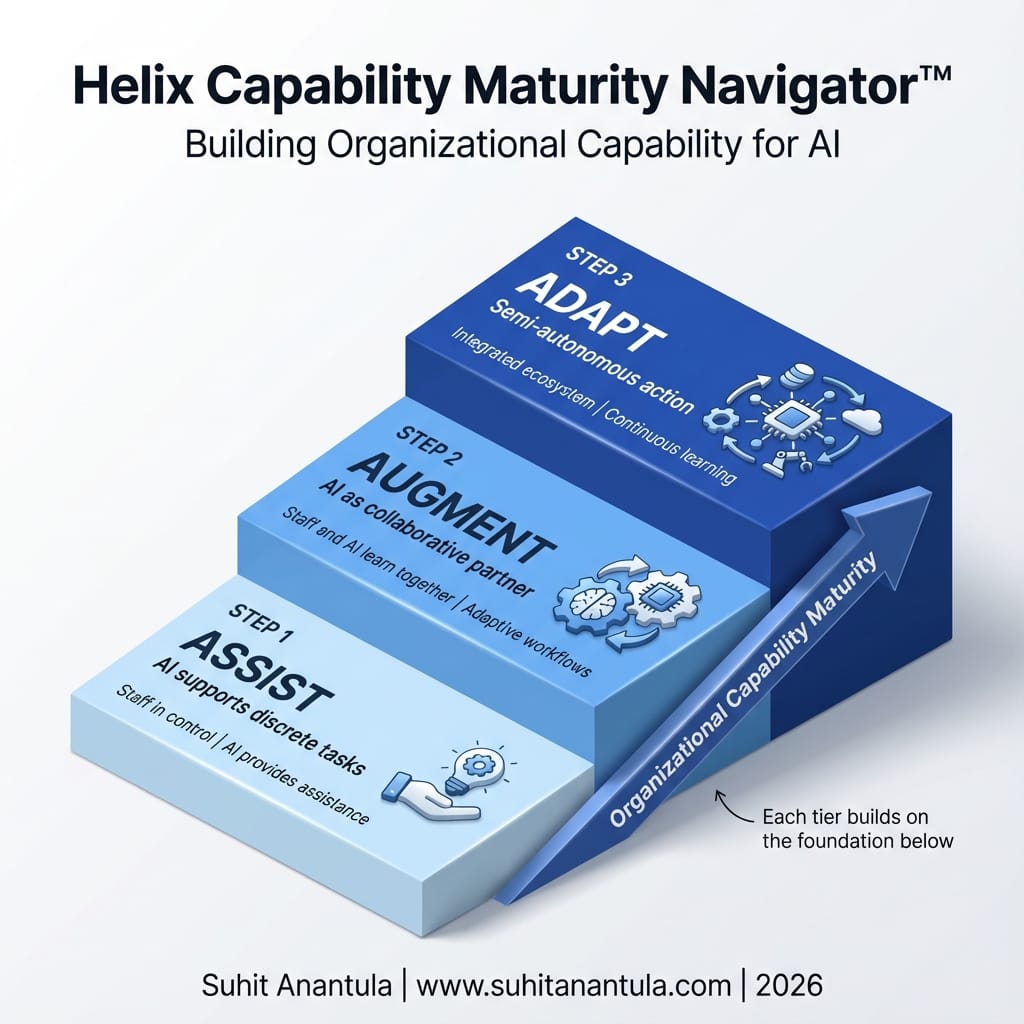
The isometric staircase visual shows the truth:
Organizational Capability Required increases with each step.
ASSIST:
- AI supports discrete tasks
- Staff in control | AI provides assistance
AUGMENT:
- AI as collaborative partner
- Staff and AI learn together | Adaptive workflows
ADAPT:
- Semi-autonomous action
- Integrated ecosystem | Continuous learning
Notice: Each step requires more organizational capability than the last.
Not just more AI capability. More organizational infrastructure.
The Intervention Opportunity
Look at the this chart.
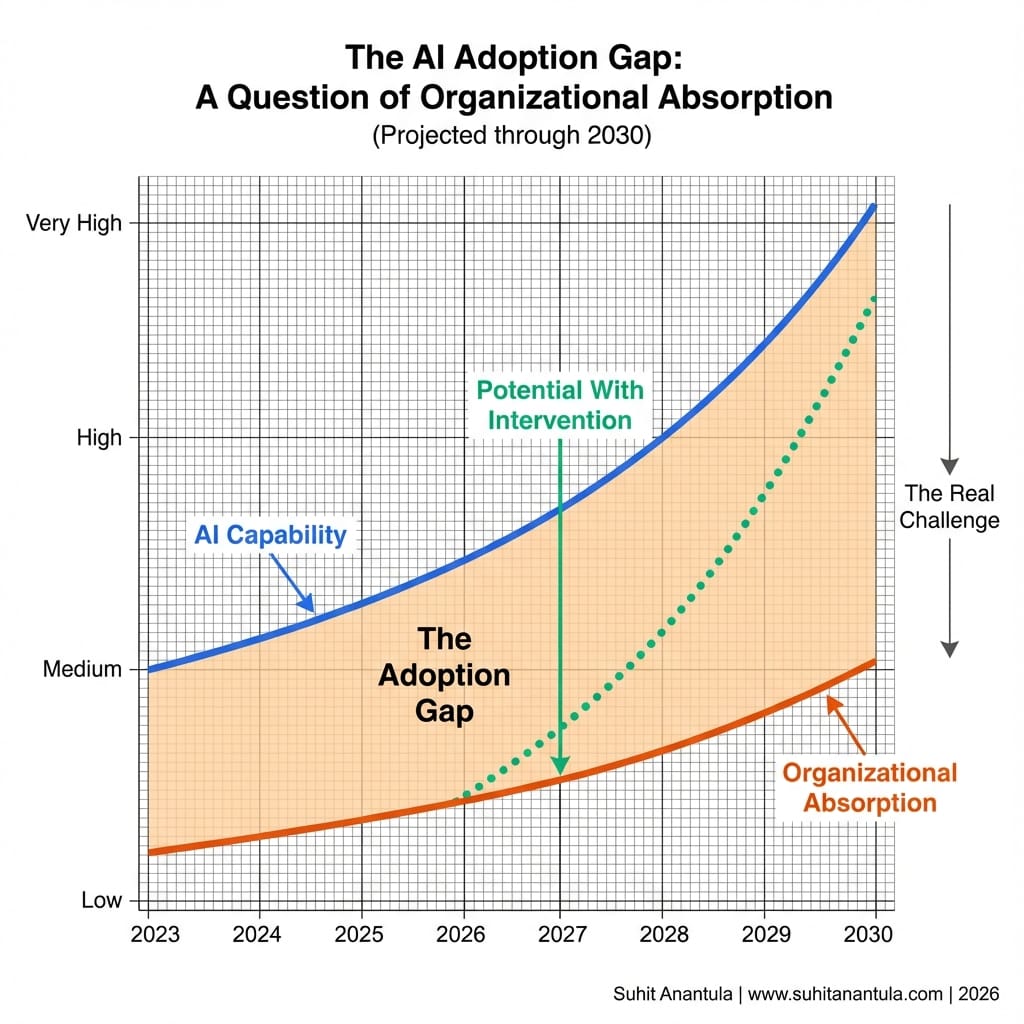
See that green dotted line? "Potential With Intervention"
That's what happens when you systematically build organizational absorption capacity.
Without intervention:
- AI capability climbs exponentially
- Organizational absorption stays flat
- The gap becomes unbridgeable
With intervention:
- Organizational absorption accelerates
- The gap shrinks
- Transformation becomes possible
The intervention isn't more AI pilots.
The intervention is building the seven dimensions of capability maturity.
What This Means for You
If you're a leader facing AI transformation, here's what to know:
1. Stop launching more AI pilots
You don't have a technology shortage. You have an absorption shortage.
More pilots without organizational readiness just creates more tissue rejection.
2. Assess where you actually are
Not where you want to be. Not where your strategy deck says you are.
Where your evidence says you are.
Use the seven dimensions. Score yourself honestly.
3. Build the foundation systematically
Assist → Augment → Adapt isn't a timeline.
It's a capability maturity journey.
You can't skip steps.
4. Focus on absorption, not adoption
Adoption is what happens when absorption is strong.
Build the substrate. The experiments will grow.
The Bottom Line
Organizations that treat AI as a technology project will keep falling behind.
Organizations that treat it as an organizational transformation will compound their advantage.
The gap isn't closing on its own.
The question isn't "what can AI do?"
The question is: "What can your organization actually absorb?"
That's the transformation that matters.
About the Helix Capability Maturity Navigator™
The Navigator provides evidence-based assessment across seven dimensions of organizational readiness for AI transformation. It helps organizations understand their true baseline, identify priority gaps, and build systematic capability from Assist → Augment → Adapt.
Want to assess your organization's AI absorption capacity?
The Helix Lab specializes in co-intelligence transformation for government and enterprise. We help organizations build the infrastructure that makes AI adoption possible—not just launching pilots, but creating the conditions for transformation.
[Contact: suhit@anantula.com | www.suhitanantula.com]