When Algorithms Ossify: The Health Star Rating Trap and how we can solve it.

How Australia's food labelling system got frozen in 2014 — and why Rules as Code could fix it
The Cornflakes Box
You're standing in your kitchen at 7am, half-awake, pouring cornflakes into a bowl. On the front of the box: 4.0 stars. Four and a half stars out of five. That's pretty good, right?
You flip the box over. The ingredients list starts with "maize, sugar, salt." The nutrition panel shows 24g of sugar per 100g — nearly a quarter of the product is sugar. But the box confidently displays those 4 stars.
The Health Star Rating (HSR) tells you this product is healthier than 90% of foods in the supermarket. Your intuition tells you something else.
Who's right?
The International Test
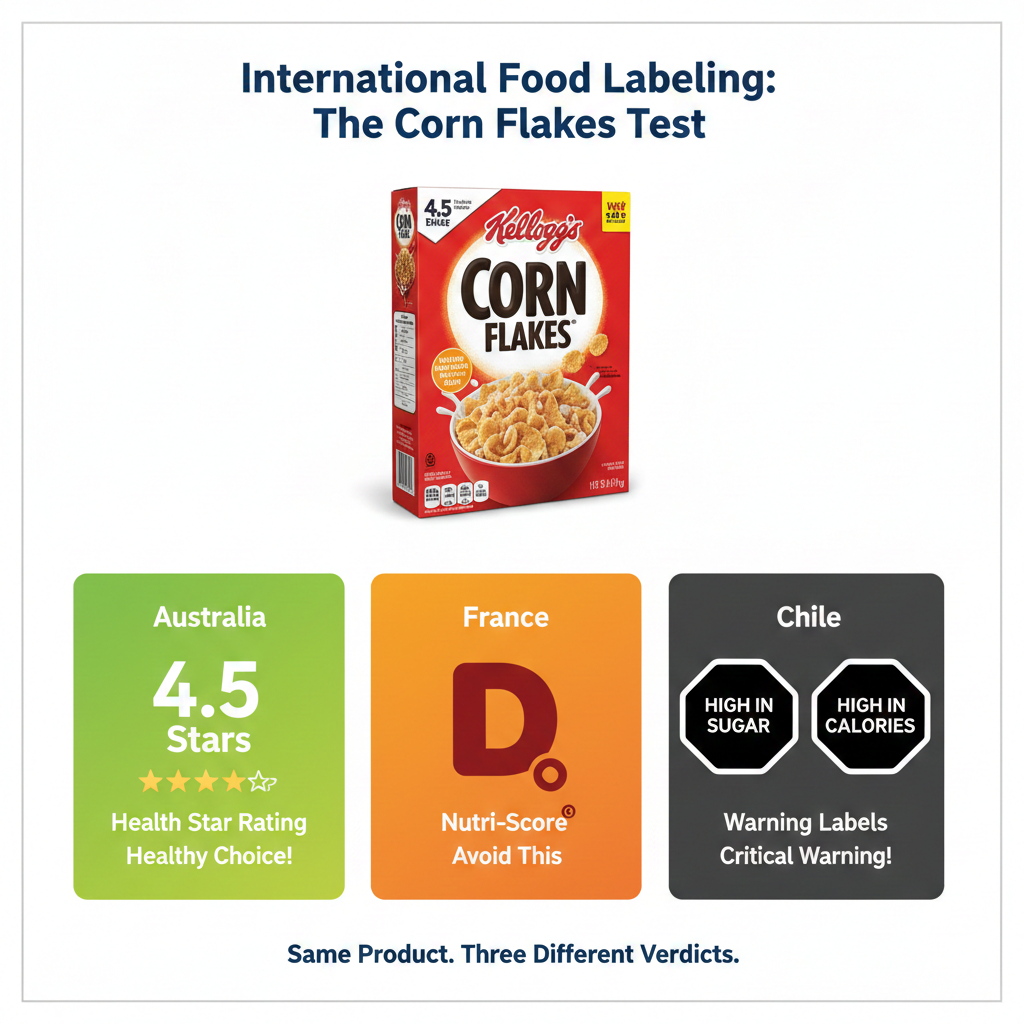
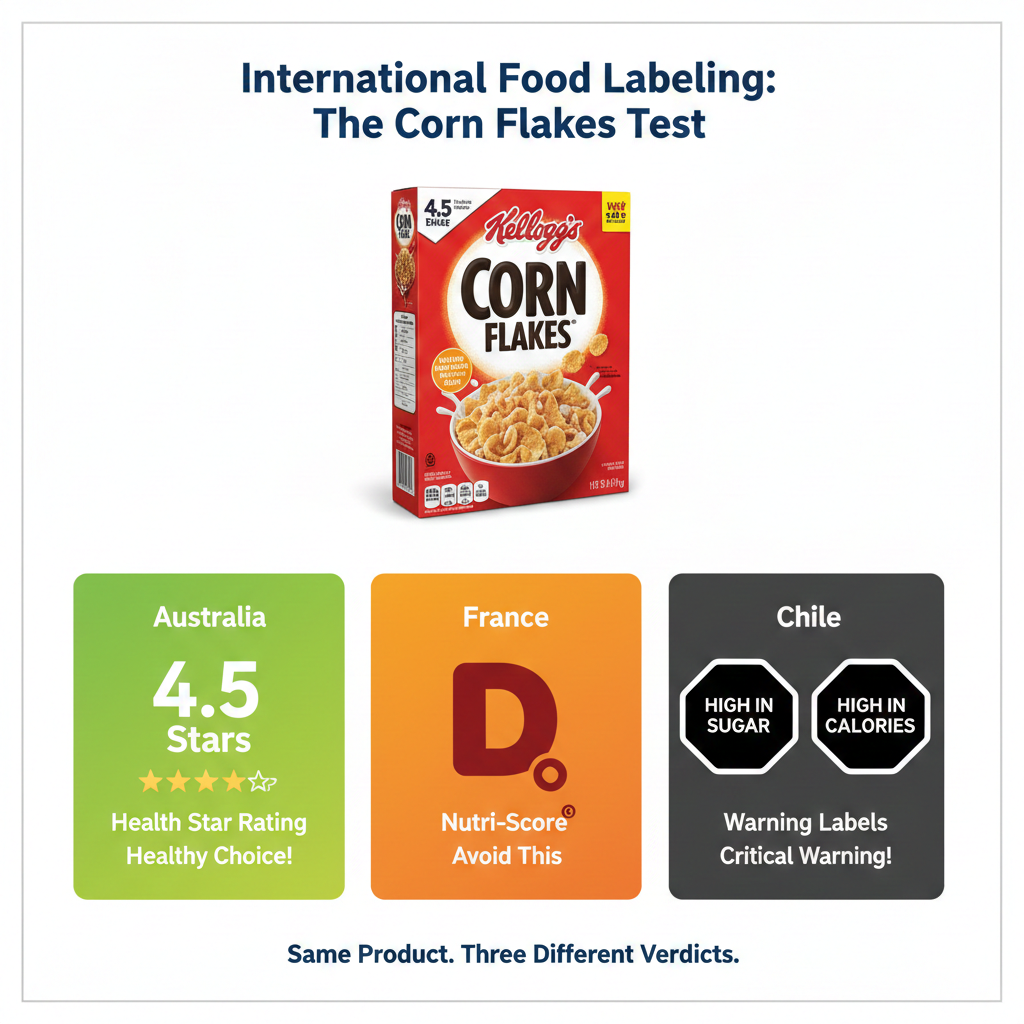
Let's run a thought experiment. Take that same box of cornflakes to France. Their Nutri-Score system rates it "D" — second-worst category (only "E" is worse).
Now take it to Chile. Their warning label system requires two black warning octagons on the front: "HIGH IN SUGAR" and "HIGH IN CALORIES."
Same product. Same ingredients. Same nutrition panel.
Three countries. Three completely different verdicts:
- Australia: 4.5 stars ⭐⭐⭐⭐ 1/2 (healthy choice!)
- France: D 🔴 (avoid this)
- Chile: ⚫⚫ HIGH IN SUGAR, HIGH IN CALORIES (warning!)
Check here how Chile helped their citizens and how France recently updated their algorithm.
What's going on?
This Isn't a Nutrition Problem. It's a Systems Design Problem.
The HSR algorithm isn't wrong because the science was bad in 2014. It's wrong because we designed a system that can't evolve when science does.
The problem isn't the stars. It's that we encoded policy as if it would never need to change — and then discovered that changing it requires:
- Reprinting millions of packages
- Reformulating thousands of products
- Renegotiating with entire industries
- Re-educating 25 million consumers
We didn't design for change. We designed for permanence.
This is a pattern you see everywhere. Climate policy. Tax code. Building regulations. Welfare eligibility. Once we encode rules, they ossify. The cost of change exceeds the cost of staying broken.
The question isn't "What should the HSR algorithm be?" The question is: "How do we design policy systems that can adapt when the world does?"
The Problem: Frozen in Time
Australia's Health Star Rating launched in 2014. It was based on the nutritional science of 2014. The algorithm — the mathematical formula that converts nutrition information into stars — was encoded, tested, and rolled out.
And then it stopped evolving.
Since 2014, nutrition science has:
- Discovered that ultra-processed foods (regardless of nutrient profile) increase risk of obesity, diabetes, cardiovascular disease, and cancer
- Learned that artificial sweeteners don't help with weight loss (WHO reversed its recommendation in 2023)
- Distinguished between added sugar (harmful) and natural sugar in whole foods (protective)
- Recognized that food structure matters — nutrients in whole foods behave differently than isolated/added nutrients
- Found that not all saturated fats are equal — dairy fats show neutral or protective effects
The HSR algorithm knows none of this.
It's still using 2014 logic:
- It ignores food processing entirely (ultra-processed cereals with added vitamins can score higher than whole foods)
- It treats artificial sweeteners as "free" (zero penalty, despite WHO guidance)
- It counts all sugars equally (an apple gets penalized the same as a soft drink)
- It applies nutrient-by-nutrient reductionism (doesn't see the food matrix)
- It uniformly penalizes saturated fat (nuts, avocados, cheese score lower than evidence warrants)
Meanwhile, other countries updated:
- France's Nutri-Score: Updated in 2019, 2021, and 2024. Now distinguishes red meat, whole grains, and added sugar.
- Chile's Warning Labels: Launched in 2016 with thresholds based on WHO 2015 guidance (which HSR ignores).
- UK's Traffic Lights: Multiple updates since 2013, category-specific thresholds.
- Singapore's Healthier Choice: Regular updates, adapted to new evidence.
Australia? Stuck in 2014.
Why This Matters
"It's just a label," you might think. "Who cares?"
Australians care. 72% of us use HSR when shopping. It influences what we buy, what companies reformulate, and what we feed our kids.
But if the science moves and the labels don't, we get:
- Misleading signals — Products that score well but nutrition science says are harmful
- Perverse incentives — Companies game the system (fortify junk food to boost stars)
- Missed opportunities — Healthy whole foods (nuts, cheese, avocado) score lower than they should
- Public trust erosion — People notice the mismatch between stars and reality
And once an algorithm ossifies, it's hard to change.
Introducing the LLV Framework
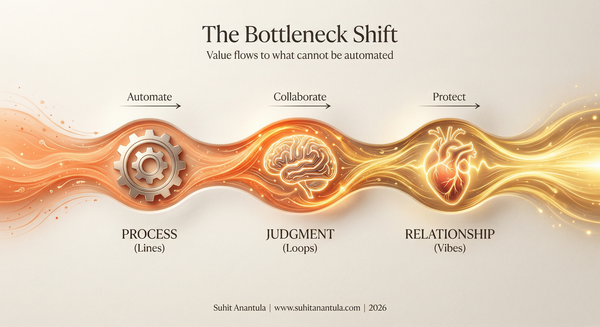
To understand why HSR ossified — and how to fix it — we need a lens that captures three dimensions simultaneously:
▲ Lines: The formal rules and algorithms (what the policy says)
● Loops: The feedback cycles and system dynamics (how the policy behaves)
〰 Vibes: The human narratives and political economy (why people resist or embrace change)
This is the LLV Framework — a systems thinking approach developed in The Helix Moment for analysing strategy challenges.
The core insight from The Helix Moment: Most organisations don't have a strategy problem. They have a rhythm problem. The same is true for policy systems.
HSR doesn't have a nutrition science problem. It has a policy rhythm problem — the system can't keep pace with the changing world because it was designed without a rhythm for adaptation.
Most policy analysis looks at only one dimension:
- Technical experts focus on ▲ Lines (fix the algorithm!)
- Systems thinkers focus on ● Loops (map the feedback cycles!)
- Political analysts focus on 〰 Vibes (understand the stakeholders!)
But all three interact in rhythm. Lines shape Loops. Loops create Vibes. Vibes determine which Lines are politically feasible. When the rhythm breaks, the system ossifies.
The HSR case is a perfect example:
| Dimension | HSR Reality | What's Broken |
|---|---|---|
| ▲ Lines | Algorithm frozen in 2014, can't distinguish added sugar from natural sugar, ignores food processing | No systematic execution of evidence updates |
| ● Loops | Industry entrenchment loop, consumer lock-in loop, governance gridlock loop — all reinforcing ossification | No experimental learning from real-world feedback |
| 〰 Vibes | Industry fears reformulation costs, government fears industry opt-out, consumers trust but feel confused | No cultural sensing of shifting expectations |
The rhythm is broken across all three dimensions:
▲ Lines operate on a 5-year review cycle (too slow)
● Loops reinforce ossification instead of adaptation (industry investment → resist change → status quo → more investment)
〰 Vibes create political gridlock (consensus governance gives any stakeholder veto power)
You can't fix the ▲ Lines (update the algorithm) without understanding the ● Loops (why changes get blocked) and the 〰 Vibes (who benefits from status quo).
The LLV Framework reveals:
- Where the system is stuck (which loops are reinforcing ossification)
- What design choices caused it (no update mechanism, consensus governance, voluntary participation)
- How to restore the rhythm (version control, continuous feedback, independent authority)
Let's dive into each dimension. Here is a quick summary if you dont want to read the deep dive.
Quick Summary: The Ossification Cycle
Here's what's happening:
The Algorithm (Lines):
- Frozen in 2014
- Uses total sugars (not added vs natural)
- Ignores food processing (NOVA classification)
- Treats artificial sweeteners as harmless
- One-size-fits-all baseline (same rules for all food categories)
The Feedback Loop (Loops):
- Public health advocates identify problems
- Industry opposes changes (costs, consumer confusion, threat to opt-out)
- Government prioritizes "uptake over accuracy" (keeping industry participation)
- Result: Incremental updates only, major issues deferred
- Status quo maintained → loop repeats
The Politics (Vibes):
- Governance gridlock: HSR Advisory Committee requires consensus; any stakeholder can veto
- Economic entrenchment: Companies that invested $50K-$200K per product in current ratings defend them
- Voluntary system paradox: Industry can threaten to leave if changes are too big
- Regulatory fatigue: Government has other priorities (COVID, cost-of-living)
- Scientific uncertainty as cover: Industry argues "science isn't settled"
Result: Policy ossification. The algorithm is frozen not because it's good, but because the system can't change it.
Deep Dive: The LLV Framework Analysis
Let's analyse this through three lenses: Lines (the rules), Loops (the feedback cycles), Vibes (the human dynamics).
Lines: When Code Becomes Concrete
The Health Star Rating is encoded. It's a mathematical formula:
HSR Score = Modifying Points - Baseline Points

Baseline Points (negative):
- Energy (kJ per 100g/ml)
- Saturated fat (g per 100g/ml)
- Total sugars (g per 100g/ml)
- Sodium (mg per 100g/ml)

Modifying Points (positive):
- Protein (g per 100g/ml)
- Fibre (g per 100g/ml)
- FVNL% (fruit/veg/nut/legume content)

Final Score → Conversion table → 0.5 to 5 stars
This is Rules as Code — policy expressed as executable logic. But it was encoded once, in 2014, and never updated.
The frozen assumptions:
| 2014 Assumption | 2025 Science | Impact |
|---|---|---|
| Total sugars = bad | Added sugar ≠ natural sugar | Fruit penalized same as soft drinks |
| Saturated fat = bad | Source matters (dairy protective) | Cheese, nuts scored lower than warranted |
| Energy density = bad | Context matters (whole vs processed) | Nuts penalized, low-cal UPFs rewarded |
| Protein = good | Source & sustainability matter | Fortified protein powder = bonus points |
| Nutrient totals matter | Food matrix & processing matter | UPF cereals can outscore whole foods |
| Artificial sweeteners = neutral | WHO now says avoid (2023) | "Zero sugar" UPFs get free pass |
Why is this a problem?
In software, frozen code is a bug waiting to happen. When the world changes (new requirements, new evidence, new threats) and the code doesn't, the system breaks.
In policy, frozen code is worse. It shapes behaviour. Companies optimise for the 2014 rules. Consumers trust the 2014 logic.
And changing it requires:
- Reprinting every package ($50K-$200K per product)
- Reformulating recipes ($100K-$500K per product)
- Re-educating consumers
- Renegotiating with industry
- Navigating Australia-NZ regulatory alignment
The algorithm becomes concrete. Literally. It's printed on millions of boxes, embedded in thousands of products, baked into industry processes. Changing it is like trying to update the foundations of a building while people are living in it.
This is policy ossification.
Loops: The Vicious Cycle
Let's map the feedback loops that keep HSR frozen.
Reinforcing Loop 1: Industry Entrenchment
Companies invest in HSR ($50K-$200K/product)
    ↓
Financial stake in current algorithm
    ↓
Oppose major changes (protect investment)
    ↓
Government defers to industry (voluntary system)
    ↓
Status quo maintained
    ↓
MORE companies invest in current system
    ↓ [Loop intensifies]
Reinforcing Loop 2: Consumer Lock-In
Consumers learn current HSR (4.5 stars = good)
    ↓
Build mental models around existing ratings
    ↓
Changes create confusion (same product, different rating)
    ↓
Government prioritizes "stability" over "accuracy"
    ↓
Ratings stay unchanged
    ↓
Consumer expectations MORE entrenched
    ↓ [Loop intensifies]
Reinforcing Loop 3: Governance Gridlock
Multi-stakeholder governance (industry, health, government)
    ↓
Consensus requirement (any player can veto)
    ↓
Lowest-common-denominator outcomes (incremental only)
    ↓
Major issues unresolved
    ↓
Stakeholders frustrated, trust erodes
    ↓
LESS willingness to compromise
    ↓ [Loop intensifies]
Balancing Loop (broken): Science → Policy
Science advances (new evidence)
    ↓
Public health advocates push for updates
    ↓
[DELAY: 5-year review cycle]
    ↓
Industry opposes (costs, confusion)
    ↓
Government balances "uptake vs accuracy"
    ↓
[DELAY: regulatory process, impact assessment]
    ↓
Incremental changes only
    ↓
Algorithm barely moves
    ↓
Science continues advancing (gap widens)
    ↓ [Loop repeats with LONGER delays]
The problem: The reinforcing loops (entrenchment, lock-in, gridlock) are stronger than the balancing loop (science → policy). Every year that passes, it gets harder to change.
What can we do, where are the leverage points:
- Speed up the balancing loop — Reduce review cycle from 5 years to annual
- Weaken the reinforcing loops — Mandate the system (remove opt-out threat), grandfather existing products (reduce reformulation costs)
- Break governance gridlock — Move from consensus to majority vote, or create independent scientific panel with authority to update algorithm
But none of these are easy. They require political will, industry buy-in, or legislative change.
Systems Design Insight:
This isn't industry being difficult or government being lazy. This is what happens when you design a policy system with:
- No update mechanism (5-year reviews too slow)
- Consensus governance (any stakeholder can veto)
- Voluntary participation (opt-out threat)
- High switching costs (packaging/reformulation)
- No grandfathering (changes create whiplash)
These design choices guarantee ossification. The system works beautifully... until the world changes. Then it breaks. And it can't fix itself.
Vibes: The Human Dynamics
Let's look at the stakeholders and their incentives.
Industry (Food Manufacturers):
- Position: Defend status quo
- Fears:
- Reformulation costs ($100K-$500K per product)
- Relabelling costs ($1-5M for 100-product portfolio)
- Consumer confusion (same product, different rating)
- Competitive disadvantage (if they update and others don't)
- Power: Can threaten to opt-out (voluntary system)
- Strategy: Demand "stability," invoke consumer confusion, request grandfathering
Public Health Advocates:
- Position: Major reform needed
- Concerns:
- Algorithm ignores ultra-processed foods
- Treats artificial sweeteners as harmless (contra WHO 2023)
- Allows gaming through fortification
- Misleads consumers
- Power: Moral authority, media attention
- Strategy: Publish critiques, pressure government, cite international systems
Government (FSANZ, Health Ministers):
- Position: Prioritize "uptake over accuracy"
- Fears:
- Industry opts out (system collapses)
- Consumer backlash (confusion, distrust)
- Regulatory burden (another fight on top of alcohol labels, PEAL, country-of-origin)
- Australia-NZ misalignment (diplomatic friction)
- Power: Authority to mandate (but hasn't used it)
- Strategy: Incremental updates, stakeholder consensus, defer major changes
Consumers:
- Position: Trust the stars (72% use it)
- Confusion: Compare across categories (4.5-star cereal vs 4.5-star yoghurt)
- Frustration: Mismatch between stars and intuition (sugary cereal = 4.5 stars?)
- Power: Buying decisions, but diffuse and unorganized
- Outcome: Misled by ossified algorithm
The core dynamic:
Industry has concentrated costs (reformulation, relabelling) and strong incentives to resist.
Public has diffuse benefits (slightly better health outcomes) and weak incentives to mobilise.
Government has political costs (industry opposition, consumer confusion) and few incentives to act.
Result: Status quo bias. The algorithm stays frozen because the pain of changing it is concentrated, and the benefit of updating it is diffuse.
The Solution: Adaptive Policy with Rules as Code + Continuous Feedback + Policy Digital Twin
Imagine a different system.
Scenario 1: Current System
2014: Algorithm encoded, printed on packages
2019: Science advances (ultra-processed foods harmful)
2024: Still waiting for major update
DELAY: 10 years
Scenario 2: Rules as Code System
2014: Algorithm encoded in version-controlled repository
2015: WHO updates free sugar guidance
     → Rules as Code update (v1.1): Distinguish added vs natural sugar
     → Testing & validation (3 months)
     → Grandfathered rollout (existing products have 3 years to update)
2017: NOVA research conclusive (UPFs harmful)
     → Rules as Code update (v1.2): Add NOVA weighting
     → Testing & validation
     → Grandfathered rollout
2023: WHO reverses on artificial sweeteners
     → Rules as Code update (v1.3): Penalize artificial sweeteners
     → Testing & validation
     → Grandfathered rollout
DELAY: Continuous updates, 3-year transitions
What's different?
These aren't just algorithm tweaks. They're systems design principles for adaptive policy.
Catherine Althaus, Pia Andrews and I recently co-authored The Policy Playbook which is getting rave reviews and you can download for free.
We introduce the idea of policy as a journey and how we need to keep the design and delivery aligned on the goals and how we continue to adapt. This is key for this.
In practice, Example: Cornflakes
I asked my AI to use the algorithm to see how it would code it if we added new science understanding to the algorithm.
Current HSR (2014 algorithm):
- Baseline Points: -10 (high energy, high sugar)
- Modifying Points: +8 (fortified with protein, fibre, vitamins)
- Score: -2 (converts to 4.5 stars)
Rules as Code (2025 algorithm):
- Baseline Points: -10 (high energy, high added sugar)
- Modifying Points: +3 (fibre, FVNL%, but fortification capped)
- NOVA Penalty: -3 (ultra-processed)
- Score: -10 (converts to 1.5 stars)
Same product. Different verdict. Matching international standards.
International Lessons
Other countries have shown this is possible.
France (Nutri-Score):
- Algorithm updates: 2019, 2021, 2024
- What changed:
- Added red meat penalty
- Increased whole grain bonus
- Distinguished added sugar
- How: Independent scientific committee with authority to update
- Result: More accurate, better correlated with health outcomes
Chile (Warning Labels):
- Launch: 2016, based on WHO 2015 guidance (free sugars)
- Thresholds: Updated in 2018 (stricter)
- Mandatory: 100% compliance, no opt-out
- Result: 25% reduction in sugary drink purchases, reformulation across categories
UK (Traffic Lights):
- Multiple updates since 2013
- Category-specific thresholds (cheese vs cereal different baselines)
- Voluntary but high uptake (60%+)
Singapore (Healthier Choice):
- Regular updates based on HPB (Health Promotion Board) reviews
- Nutrient-specific programs (Nutri-Grade for drinks added 2023)
What they have in common:
- Regular reviews (not 5-year cycles)
- Independent scientific authority (not consensus governance)
- Willingness to update (algorithm evolves with science)
Designing Policy Systems That Can Learn
Australia's Health Star Rating is frozen in 2014. Nutrition science moved on. Policy didn't.
The result:
- Consumers misled by outdated ratings
- Industry optimizing for obsolete rules
- Public health goals undermined
- Trust in the system eroding
This is policy ossification — when the cost of change exceeds the cost of staying broken.
But here's the thing: This isn't unique to HSR.
Look around. How many of our policy systems are frozen in time?
Climate policy encoded around 2°C targets when 1.5°C became the threshold
Tax code designed for industrial economy, struggling with platform work and crypto
Building codes locked into materials/methods from decades ago
Welfare eligibility with thresholds that don't adjust to cost-of-living
Procurement rules written before AI agents existed
The pattern is everywhere: We encode policy. The world changes. The policy doesn't. The gap widens. The system breaks. And we discover that changing it requires reprinting, reformulating, renegotiating, re-educating — until the cost of change exceeds the cost of staying broken.
Policy ossification is a design flaw, not a political failure.
The Real Question
The HSR story is bigger than food labels. It's about how we design policy in a world that won't stop changing.
Right now, we treat policy like concrete — mix it, pour it, let it harden, then discover we need to jackhammer through it when reality shifts.
Rules as Code offers a different model: An adaptive policy approach — version-controlled, testable, updateable, reversible. (This builds on the adaptive policy framework from The Policy Playbook.)
The choice between these models determines everything:
| Concrete Model (Current) | Adaptive Model (Rules as Code) |
|---|---|
| Encode once, change rarely | Version-controlled, continuous updates |
| 5-year review cycles | Annual reviews by independent panel |
| Consensus governance (veto power) | Scientific authority (evidence-based) |
| Voluntary participation (opt-out threat) | Mandatory with grandfathering |
| High switching costs | Transition periods (3 years) |
| Opaque reasoning | Transparent repository |
| Can't test before rollout | Simulate impacts first |
| Mistakes are permanent | Reversible if needed |
These aren't minor technical differences. They're fundamentally different philosophies of governance.
Concrete model: Assume the future will look like the present. Encode rules. Resist change.
Adaptive model: Assume the future will be different. Build systems that can adapt.
What This Means for Australia
If we want institutions that can keep pace with reality, we need to redesign how we encode policy.
- Ask: Can this system adapt when the world changes?
- Design for: Version control, continuous feedback, independent authority, transparency, testability, reversibility
- Avoid: Consensus governance, voluntary participation, high switching costs, opaque reasoning
Next Steps:
If you want to see the detailed LLV framework analysis, technical algorithm breakdown, and a worked example of encoding HSR as Rules as Code, Part 2 is coming next week.
If you're working on policy systems that need to adapt, or you're building Rules as Code capabilities in your organization, let's talk. The Helix Lab specializes in systems design for complex policy challenges.
Contact: suhit@anantula.com
Learn more:
- LLV Framework: The Helix Moment — www.thehelixmoment.com
- Adaptive Policy: The Policy Playbook - www.thepolicyplaybook.org