01_The F1 Revolution : The Co-Intelligent Org


Continuing the series for the book The Co-Intelligent Organisation.
The One-Second War
Lap 49 of the 2021 Russian Grand Prix. Lando Norris is four laps away from his first-ever Formula 1 victory, his McLaren dancing on the edge of adhesion as he holds off the seven-time world champion, Lewis Hamilton.
But high above the Sochi Autodrome, a weather front is collapsing.
On the pit wall, the team's probabilistic models digest 1.1 million data points per second—Doppler radar vectors, tire degradation curves, and air density shifts—and resolve into a single, blinking command: Box.
The machine knows, with near-mathematical certainty, that the track will become un-drivable in ninety seconds.
But inside the cockpit, the human sensor network disagrees. Norris feels the grip in his fingertips; he sees a dry racing line. When his engineer urges him to pit, the adrenaline-fueled pilot overrides the digital forecast with a scream of defiance: "NO!"
One second behind him, Lewis Hamilton faces the exact same choice. He, too, feels the grip holding. He, too, wants to brave the elements. But when the Mercedes algorithm insists, Hamilton suppresses his instinct, trusts the invisible data, and dives into the pits.
For sixty agonizing seconds, the two drivers exist in parallel realities—one betting on the biological "now," the other on the digital "next."
Then, the heavens open.
Norris is helpless, his car turning into a toboggan on the ice-like surface as he slides off the track, watching his maiden win evaporate in the spray. Hamilton, on the correct tires, cruises past to take the victory.
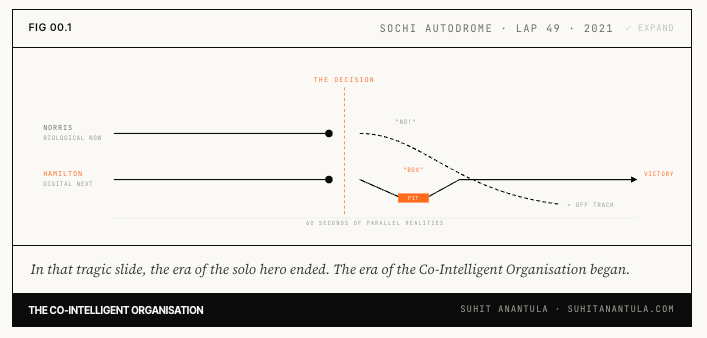
In that tragic slide, the era of the solo hero ended. The era of the Co-Intelligent Organisation began.
Hamilton had spent a decade building a relationship not just with his race engineer, but with the machine intelligence that backed him. He knew that when the "Box" command came with that level of urgency, the algorithm was seeing something his eyes couldn't. He had sufficient Trust Capital to override his own biological senses.
Norris, brilliant but younger, driving for a team still finding its championship form, trusted his hands more than his dashboard. He had the intelligence (the data said pit), but he lacked the trust to act on it.
This is the exact situation facing every CEO, every team leader, and every knowledge worker today.
Continue reading on the book site.