The 9Q Grid -- Strategy Canvas for the Co-Intelligent Organisation

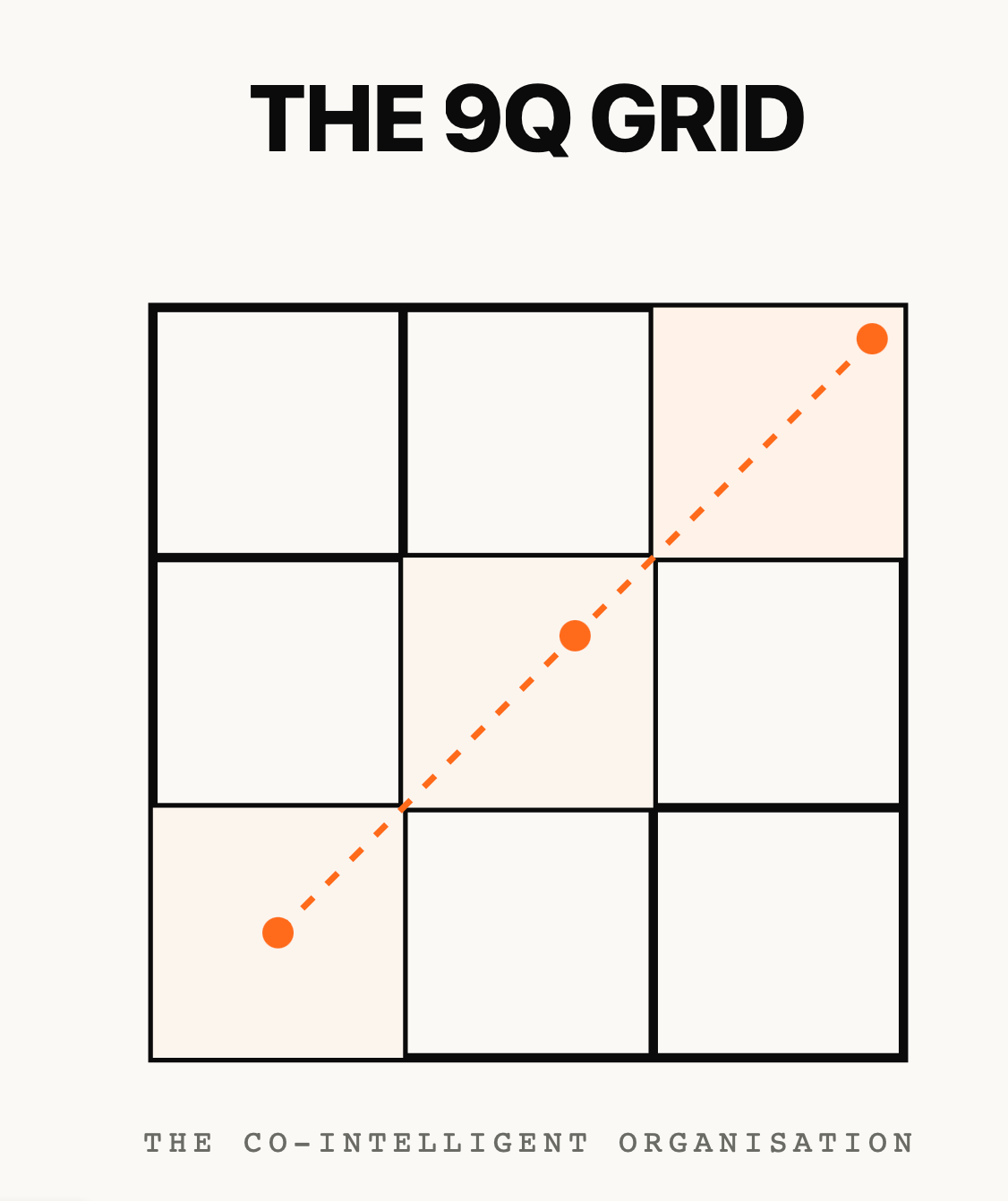
As we enter the co-intelligent era, understanding where humans plan a role and where does machine intelligence play a role is critical.
Over the years we have had many tools and frameworks to help us. In strategy we have the BCG matrix, Five Forces from Porter and recently the business model canvas.
When machine intelligence is abundant and humans have to figure out what they do and companies need a AI strategy, what do we do. That is the 9Q grid.
This chapter introduces the 9Q grid and we build on this in the subsequent chapters and beyond.
Please read, download, engage and work with me as we explore what a strategy canvas for the co-intelligent organisation looks like.
Ch 3: The 9Q Grid
The Map Before the Journey
Every race begins with a map.
Not a destination. Not a plan. A map.
Before Red Bull designs a car, they study the track layout. Bahrain has long straights and heavy braking zones. Monaco is tight corners and no overtaking. Singapore is street circuits under lights. Spa is elevation changes and unpredictable weather.
The same car won't win everywhere. The same setup won't work on every track.
Strategy begins with knowing the terrain.
Most organisations approach AI like a driver who shows up without studying the circuit. They have capability. They have budget. They have ambition. But they don't know where they are actually racing.
"We need an AI strategy" isn't a strategy. It's a wish.
A strategy requires a map. A map that shows you not just where you are, but where you could be. Not just what AI can do, but what kind of work it is doing, what degree of agency it holds, and what that implies for trust, governance, and value creation.
In Helix language, this is portfolio positioning: where are you now, where should you be next, and what sequence of moves gets you there without pretending every AI bet carries the same risk or return?
The 9Q Grid is that map.
In the last chapter we met the Co-Intelligent Org and the question "Who does the thinking?". The 9Q Grid is how we turn that question into a map you can actually draw.
One Grammar, Two Dimensions
Here's what took me years to understand.
There is a pattern that appears everywhere in human-AI collaboration. It shows up in how customers experience AI. It shows up in how teams do work. It shows up in how organisations mature.
The same pattern. Three stages. One grammar.
ASSIST means the AI helps while the human leads. The machine accelerates the work, but the work keeps the same shape.
AUGMENT means human and AI iterate together. The machine narrows options, surfaces patterns, drafts possibilities. The human judges, refines, and decides.
ADAPT means the AI acts while the human governs. The human sets boundaries, purpose, and escalation rules; the machine executes inside them.
That grammar is the vertical axis of the 9Q Grid.
But the second insight is what makes the grid really useful:
AI does not just vary by capability. It also varies by the kind of work it is doing.
Some work is structured. Some is dynamic. Some is genuinely complex.
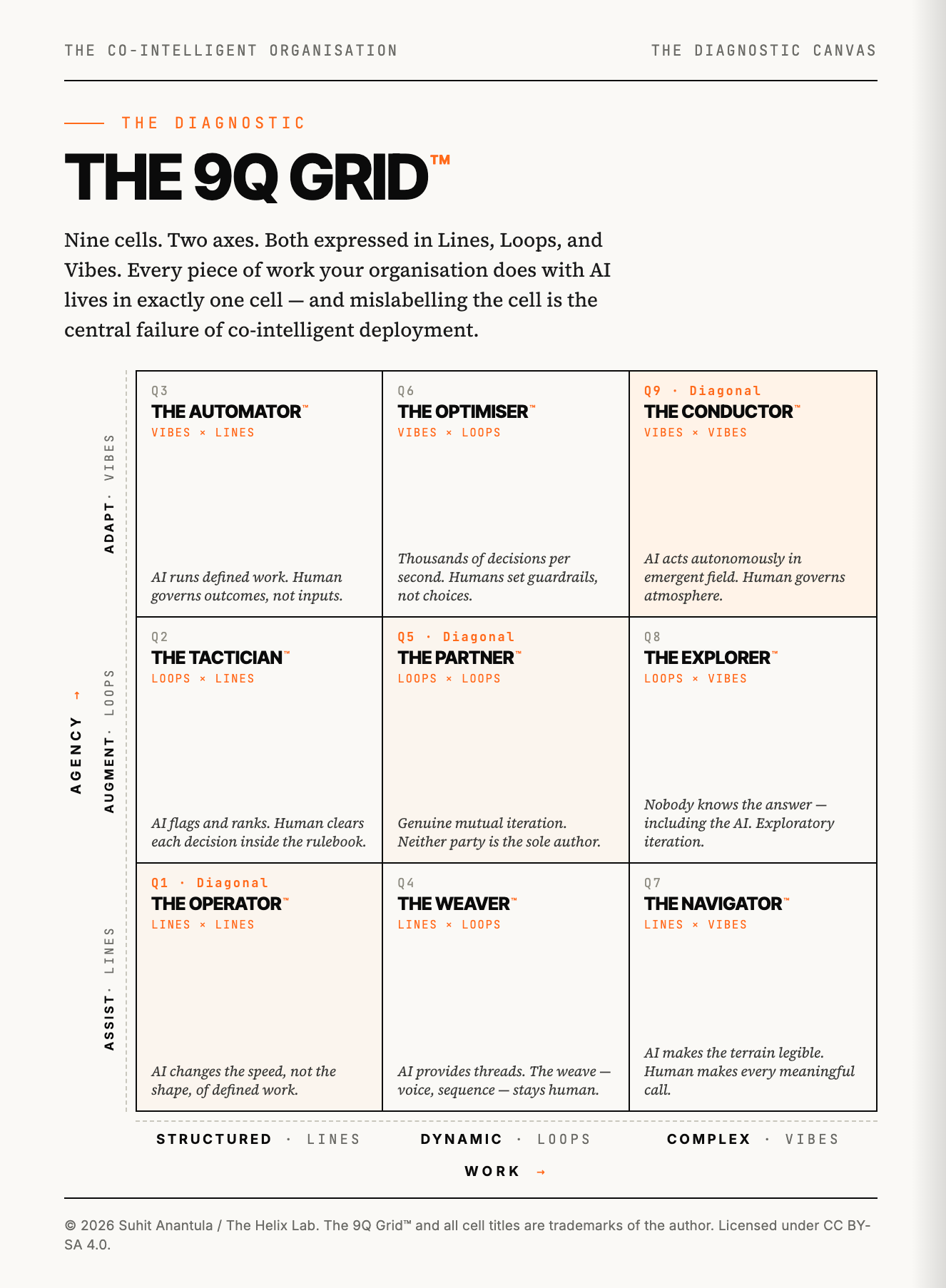
When you cross those two dimensions, nine distinct archetypes emerge.
The Two Axes
Axis 1: Agency
The vertical axis asks: How much agency does the AI hold in the work?
| Level | Name | Meaning | Human role |
|---|---|---|---|
| 1 | Assist | AI helps, human leads | At the helm |
| 2 | Augment | Human and AI iterate together | In the loop |
| 3 | Adapt | AI acts, human governs | On call |
This is not a ladder of "better." It is a ladder of agency.
The higher you go, the more trust the organisation must spend and the more governance it must have already earned.
In Part 4, you will see what this grammar looks like running at 300 kilometres an hour.
Axis 2: Work
The horizontal axis asks: What kind of work is this?
| Level | Name | Meaning |
|---|---|---|
| 1 | Structured | Defined, repeatable, rules-heavy work |
| 2 | Dynamic | Iterative, changing, feedback-rich work |
| 3 | Complex | Emergent, ambiguous, hard-to-specify work |
This matters because a brilliant AI deployment in structured work is not the same as a brilliant AI deployment in complex work. The governance challenge is different. The value mechanism is different. The failure mode is different.
Agency tells you who acts. Work tells you what kind of terrain they are acting in.
More in the book chapter or you can download the 9Q grid here.