The Co-Intelligent Vision

Not Humans OR AI. Humans WITH AI.
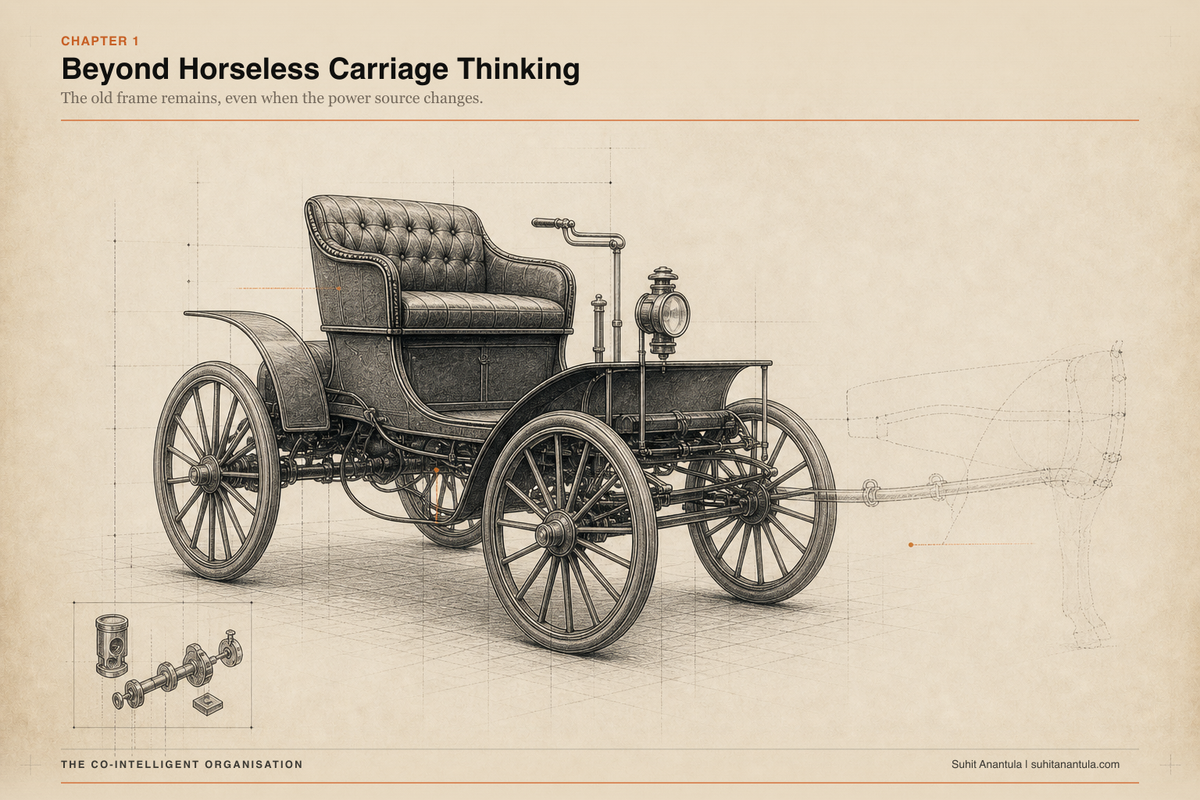
In early days of automobiles, we called them "horseless carriages."
The name revealed our thinking. We understood new technology only in terms of what it replaced. A carriage—without a horse. The frame of reference was old world.
It took decades before we stopped thinking about what was missing and started thinking about what was possible. Roads, highways, suburbs, supply chains, global commerce—none of it was imaginable when we were still mentally tethered to horse.
We're making the same mistake with AI.
Most organisations think about AI in terms of replacement. Which jobs will it eliminate? Which tasks can it do instead of humans? How many people can we remove?
This is horseless carriage thinking.
The Co-Intelligent Organisation doesn't ask: "What can AI do instead of us?"
It asks: "What can we become together?"
"The Co-Intelligent Organisation doesn't ask: 'What can AI do instead of us?' It asks: 'What can we become together?'"
The Definition
A Co-Intelligent Organisation is one where human and artificial intelligence are designed to amplify each other.
In this book, we'll keep returning to Formula 1 as our living laboratory for that question — the sport where human and machine already think together in real time, under race conditions.
Not humans using AI tools. Not AI replacing human workers. A genuine synthesis—where neither could achieve alone what they accomplish together.
Four characteristics define a Co-Intelligent Organisation:

1. Leaders orchestrate human and AI intelligence
The leader's job isn't to do the work. It's to direct the cognitive resources—human and artificial—toward outcomes. Like Hannah Schmitz on the pit wall, receiving AI simulations and human intuition, then making the call.
The old identity: "I'm the leader of humans and expert who knows the answer." The new identity: "I'm the conductor who synthesises the system."
As Ruth Buscombe, former Head of Race Strategy at Alfa Romeo F1, puts it:
"The idea of a gut instinct in Formula One is actually just a summation of all your experiences... It's actually a summation of numbers that are going on in your head that your conscious brain isn't aware of." — Ruth Buscombe, former Head of Race Strategy, Alfa Romeo F1
The Co-Intelligent Leader uses this "new intuition"—a synthesis of data and experience.
2. Teams include AI as collaborative members
In Lloyds Banking Group's Project Turing experiment, three teams competed: human-only, AI-only, and human+AI. The hybrid team's work was judged "most human" by a blind panel.
The explanation is counterintuitive. AI didn't replace human creativity—it gave humans more time for it. Volume enabled depth. When AI handled the collecting, humans could focus on the connecting.
The Co-Intelligent Organisation designs teams where AI is a member, not just a tool.
3. Structures are designed for human-AI workflows
BNY Mellon has 100 "digital employees" in production. They have login credentials. Email addresses. Human managers. Onboarding processes. Performance reviews.
This sounds like a stunt. It's not.
It's the inevitable conclusion of treating AI as organisational infrastructure, not just technology. If AI is doing work, it needs to be managed, governed, and integrated—just like human workers.
The Co-Intelligent Organisation doesn't bolt AI onto existing structures. It redesigns structures for human-AI flow.
4. Workflows continuously learn and adapt
The most important shift isn't about adding AI. It's about reimagining and building learning loops.
A traditional workflow is static: input → process → output. A co-intelligent workflow evolves: input → process → output → feedback → adaptation → improved process.
The AI learns from the work. The humans learn from the AI's patterns. The workflow gets better over time. This is what separates automation from intelligence.
Pit Stop · 02.1
Design the relationship, not the tool.
Co-intelligence is not a feature list. It is the designed relationship between leadership, teams, structures, and workflows so the system can think better than either humans or AI could alone.
More on the book site.