The next software category: co-intelligent tools

If markdown is the co-intelligent document format, what is a co-intelligent tool?
Salesforce, one of the companies that helped create the SaaS era, is now showing us what comes next.
For the past two decades, SaaS software was built for humans. We were the users. We clicked the buttons, filled in the forms, moved across the interface, and made the software work.
Now that is changing.
Salesforce has been moving toward the agentic wave for a while. Einstein AI and Agentforce were useful steps, but they were still built on the assumptions of the SaaS world: software for human users, with AI added in.
This week, Salesforce announced Headless 360, CLIs, and MCPs.
That matters.
Because it signals something much bigger than a product update:
in the co-intelligent era, software will be built for both humans and agents.
Humans will use websites and apps.
Agents will use CLIs and MCPs.
And the important software category of the next decade will be the tools that support both.
So what is a co-intelligent tool?
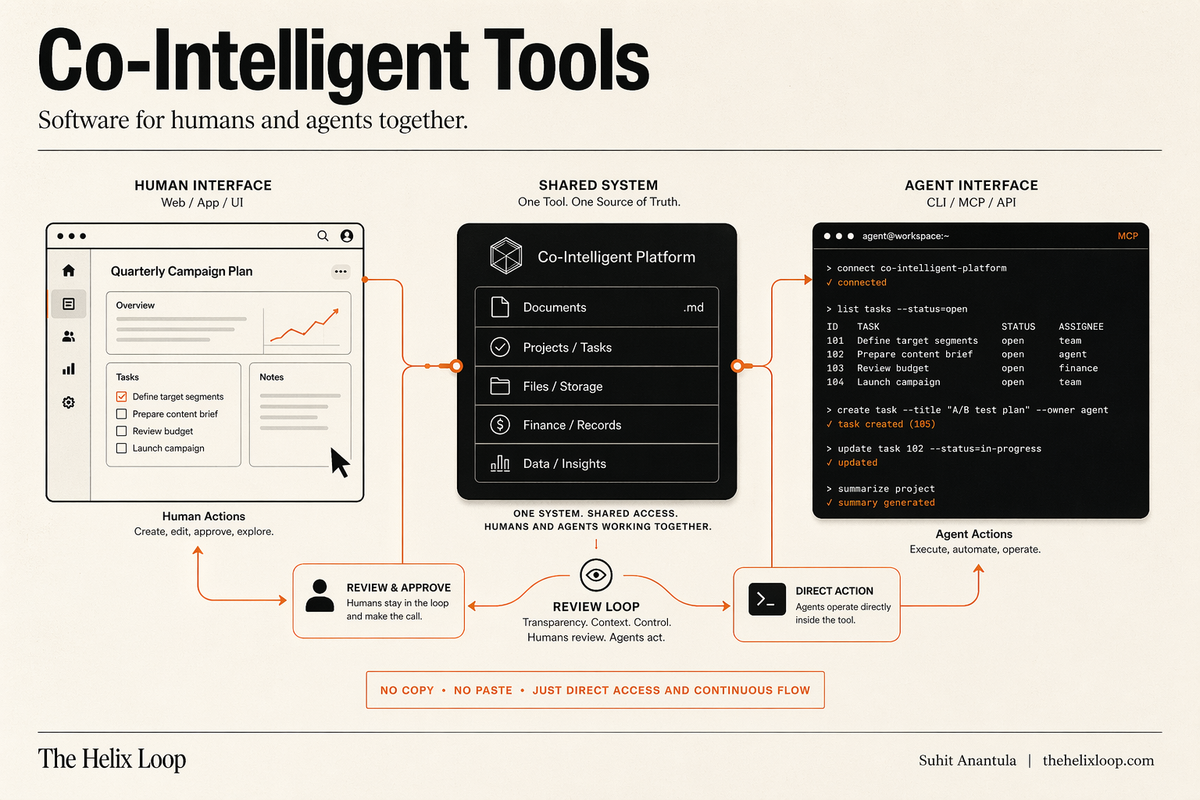
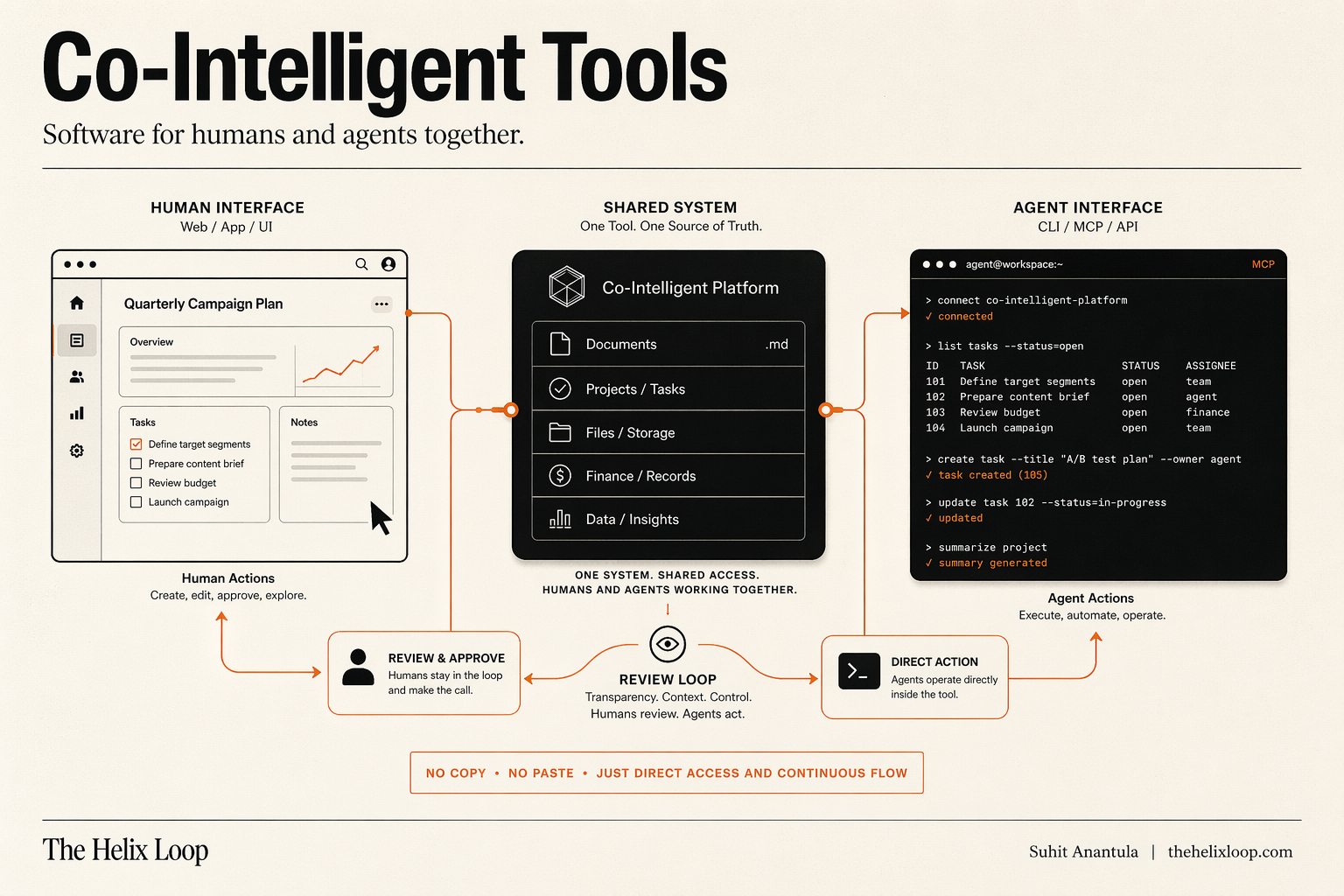
A co-intelligent tool is a tool designed for shared human-agent work.
It has:
- a human interface
- an agent interface
- shared access to the same underlying system
- a review loop between human and agent
- the ability to move from instruction to action without copy-paste
That last point matters more than most people realise.
If you are still copy-pasting, you are not in the agentic era. And you are definitely not in the co-intelligent era.
Copy-paste is the old workflow.
Co-intelligent work means the agent can operate directly in the tool, and you can see, review, redirect, and continue.
That is a different operating model.
Why does this matter to you as a leader?
Because in the co-intelligent era, the question is not just which software your teams use.
It is whether that software can support a new way of working.
The tools you choose will increasingly determine:
- whether your people and agents can work together directly
- whether workflows stay trapped in interfaces built only for humans
- whether your organisation is actually becoming co-intelligent, or just adding AI features on top of old habits
This is now one of my principles: any tool I use should be useful to me and my agents.
It should have both a human interface and an agent interface. And when those two work together cleanly, I see it as a co-intelligent tool.
What does that look like in practice?
Documents: Markdown.
Markdown has become the default format for humans and agents working on the same content.
Project management: Linear or Basecamp.
Why? Because they are moving toward agent-native workflows through CLIs and MCPs. Humans can work in the web interface. Agents can work directly through the tool layer.
Document storage: Box.
For a long time I used Google Drive and OneDrive. Lately I have moved Helix Lab to Box. Why? Because Aaron Levie saw where this was going. Box has a CLI, which means it stops being just cloud storage and starts becoming part of an AI-native workflow. Google is now moving in the same direction with a Google Workspace CLI.
Finance: Xero. (Almost there)
Xero is getting there. They are not fully there yet, but once you get access through their MCP, Claude Code can work directly with Xero. That means I can understand my finances, code my transactions, and prepare for BAS by talking to my AI while it works directly inside the system.
And this is the real flip
I do not type much anymore.
I speak through VoiceInk. It transcribes directly to the AI. The AI works directly with my tools, whether that is Basecamp, Box, or Xero. I review what it does, speak
again, and keep moving.
That is a new workflow.
It is a new way of accessing information.
A new way of directing work.
A new way of performing knowledge work.
And it changes what you can do.
More importantly, it changes how your teams will perform.
The next software filter
In the SaaS era, the question was: does this software work well for humans?
In the co-intelligent era, the question becomes:
does this tool work well for humans and agents together?
If you build software, it is becoming inevitable that you will need both a human interface and an agent interface.
If you buy software, you need to start asking which tools are co-intelligent and which are not.
Because that is the next real divide.